“Wherever we had been in Russia, in Moscow, in the Ukraine, in Stalingrad, the magical name of Georgia came up constantly. People who had never been there, and who possibly never could go there, spoke of Georgia with a kind of longing and a great admiration. […] [T]hey spoke of the country in the Caucasus and around the Black Sea as a kind of second heaven. Indeed, we began to believe that most Russians hope that if they live very good and virtuous lives, they will go not to heaven, but to Georgia, when they die. It is a country favored in climate, very rich in soil, and it has its own little ocean.”
John Steinbeck, “A Russian Journal”, 1948
Dreams come true and thoughts materialise, more often than you think, provided that your thought process is at the right wavelength, so to speak. 😊 Georgia had been on my mind for a long long time — I grew up reading great Russian poets whose works were inspired by Georgia, studying the Patriotic War of 1812 and the pivotal role Prince Bagration played in Russia’s resistance against Napoleon, watching great Soviet films about Georgia (I’m thinking, in particular, about Mimino — full version with English subtitles is available on youtube, if you fancy some quality entertainment) and drinking Borjomi. Georgia to me — like, I think, to many people of the Soviet and post-Soviet generation — had always been surrounded by an air of mystery and romanticism, which is a very alluring combination indeed.
And so when my friend Justina told me a few months ago that she had been planning a trip to Georgia with a few of her friends, I shamelessly invited myself to join them. They kindly admitted me to Team Georgia and, fast forward to the end of May, I was excitingly packing my backpack in anticipation of a 9 day long adventure in this beautiful country in the heart of Caucasus.

So good to feel the weight of the backpack again!
Adventures (read: the author embarrassing herself) began on the way to the airport already. Justina and I were excitedly chatting away in anticipation of the trip. I started telling her, rather loudly and animatedly, about the advice my grandma gave me before we set off. She warned me, with real concern in her voice, that a girl ought to be careful with Georgian men because they are such “sweet talkers“. I then told Justina about John Steinbeck’s description of Georgians in his book “A Russian Journal” (see also the above quotation; now is also the time to admit that I drew inspiration from the title of his book for this blog post 😜): “They spoke of Georgians as supermen, as great drinkers, great dancers, great musicians, great workers and lovers“. Two young guys, who were sitting right in front of us, then turned around. It transpired that they were Georgian and looked evidently pleased. They engaged us in a conversation, asking, amongst other things, how my grandmother acquired this knowledge. I like to think of myself as a confident and independent woman, but invariably I blush like a schoolgirl every time I find myself in situations such as this one. 🙈
Our flight was with Georgian Airways, departing at 22:50. We got to the airport quite early to avoid any unnecessary “oh-my-gosh-we-are-going-to-miss-our-flight” stress, but we needn’t have worried — Gatwick resembled a bit of a ghost town and we cleared security with plenty of time to spare, which we used to indulgently sip champagne in Jamie’s Italian. Direct London-Tbilisi flight with Georgian Airways was only introduced relatively recently, and it’s great: you leave London quite late, sleep on the plane (a sleeping pill and red wine is a powerful combination) and, some 5 hours later, your are in Tbilisi (+3 GMT), ready to start the day.
When we took off, Justina volunteered to be on food duty. I put my sleeping mask on, relying on her to wake me up when the food arrived, but she failed miserably at this task, having fallen asleep while on duty. I woke up around 1am, with the smell of sausages tickling my nostrils, just in time for our early morning dinner. The food was crazy — buckwheat, sausages and beetroot salad, accompanied by some bread, a chunk of butter and slices of good old kolbasa (Soviet style salami).
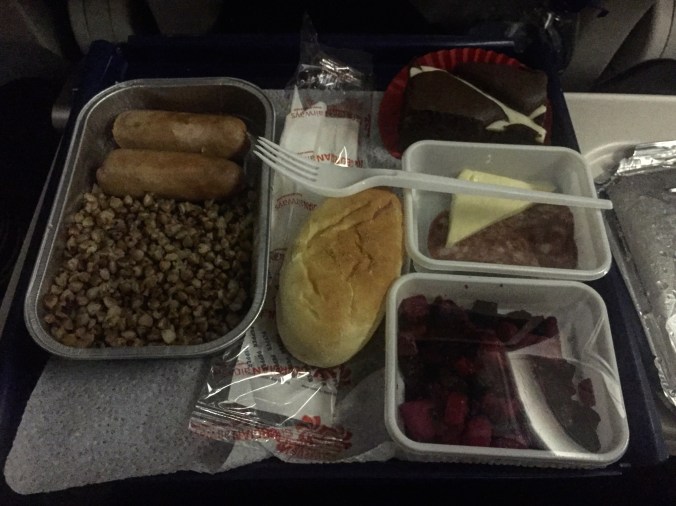
Georgian Airways flight food — yum!
It didn’t look all that appealing and it took me all the way back to my childhood days in the mid-1990s — but, to out great surprise, it was actually delicious. We gobbled our early morning meal and went back to sleep, satisfied.
…
Our plane landed in Tbilisi at 6:30am local time. The owner of the AirBNB flat where we we staying arranged for someone to pick us up from the airport and take us to our home for the next 3 nights. After some confusion, we found our driver, Alfred, an absolutely delightful man, probably in his early 60s. As we drove to the place, Alfred told us the history of and various fascinating random facts about Tbilisi. He told us that many people, especially the young, have left, mostly to work in Moscow (according to this World Bank data, personal remittances as a % of GDP are pretty high, at 10.4% — though this is nothing compared to Tajikistan; when I visited the country in 2014, I was shocked to find out that remittances account for c. 1/4 of the country’s GDP).
After half an hour or so, we arrived at the property, and I was instantly in love. It was one of those old, slightly dishevelled houses, with lots of flats and a circular ‘Italian yard’, with neighbours sitting outside under an awning, drinking home made wine and playing Russian draughts, and children playing and running around. In short, the house was full of character and exuded a warm welcome.
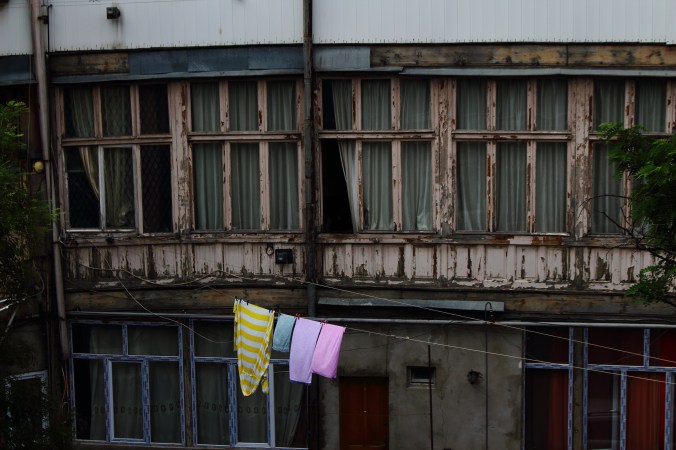
Our home for the first few nights in Tbilisi.
Alfred showed us into out flat, and it also didn’t disappoint — it was incredibly spacious and even had a piano in one of the bedrooms. The only slightly disconcerting thing was the artwork, which included a picture of a clown hung right above one of the beds. Justina and I quickly decided that we were going to allocate the clown bedroom to Abe, who was due to arrive the next day.
…
After a little power nap, we began to get ready to explore the city. Suddenly, our door bell rang. Slightly perplexed — we were not expecting anyone — I opened the door. A man stood there, holding a plastic bottle of something red. “I’m your neighbour — here’s some homemade wine especially for you,” — he said in Russian, handed over the bottle of wine to me and left before I could even say thank you. Virtually everyone had heard about Georgian hospitality, and we were quite moved to experience it within an hour of checking into our flat.
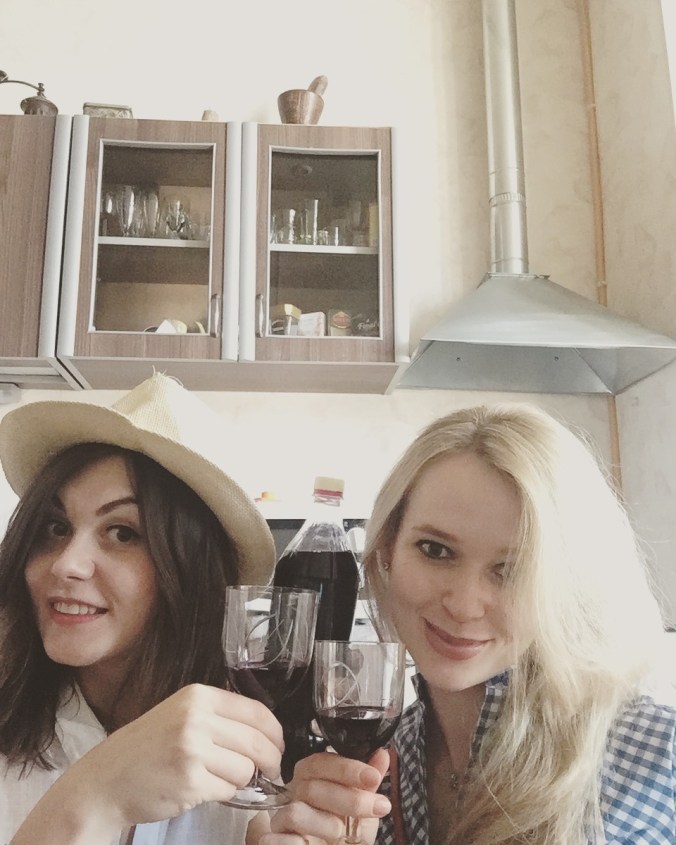
Only in Georgia.
Having savoured the wine, we made our way into the old town. On the way, we stopped at a little kiosk recommended by Alfred for some great khachapuri. There will be more on Georgian cuisine later but for now, I should explain that khachapuri is one of the most iconic Georgian dishes. It’s very simple — it is, essentially, bread with cheese, which comes in many shapes and flavours. It is everywhere in Georgia — I read somewhere that it is a Georgian equivalent of fast food. Khachapuri are absolutely divine. During our Georgian trip, we consumed so many that I literally lost count. Anyway, as we were about to pay at the kiosk, a Georgian man appeared out of nowhere and insisted on paying for our khachapuri; he told us it was his “treat”. We protested but the kiosk lady refused to accept money from us outright, so eventually we had to give in to this further manifestation of Georgian hospitality.
Aside from Georgian hospitality, we soon discovered that another stereotype about Georgians was also not unsubstantiated — and it was, ironically, what my grandmother “warned” me about. During out first day in Tbilisi, as well as during our second day before Abe joined us, it would be fair to say that we were approached by many Georgian men. They were all, just as my grandmother said, ‘sweet talkers’: funny and charming and interesting (one guy, for instance, was very interested in discussing the subject of my camera’s aperture with me). They were also respectful and took a polite no for an answer. (Aside from Otta, the guy who we met just before Abe joined us. Otta told us he was a producer of music videos and, whilst he ticked other boxes (he spoke about Kafka, religion, his passion for motorcycles and his approach to living life, which he described as “akin to walking on the blade of a knife”), he did not like our ‘no’, and kept insisting, for a long time and rather bizarrely, that we should join him for a carbonara. 😬 He kept saying that life is about sharing and that he wanted to share a conversation and some carbonara with such beautiful girls.)
We walked to the Old Town via the Peace Bridge over the Mtkvari river. The Peace Bridge is a Saakashvili era creation; it was designed by an Italian architect Michele De Lucchi and opened in 2010.
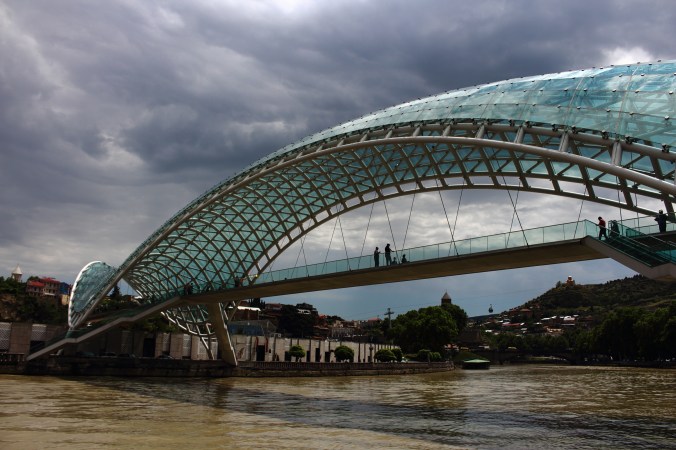
Peace Bridge
Apparently, it’s very divisive — people either love it or hate it, but we actually quite liked it. It is an elegant structure, which gives the impression almost as if it was suspended in the air.
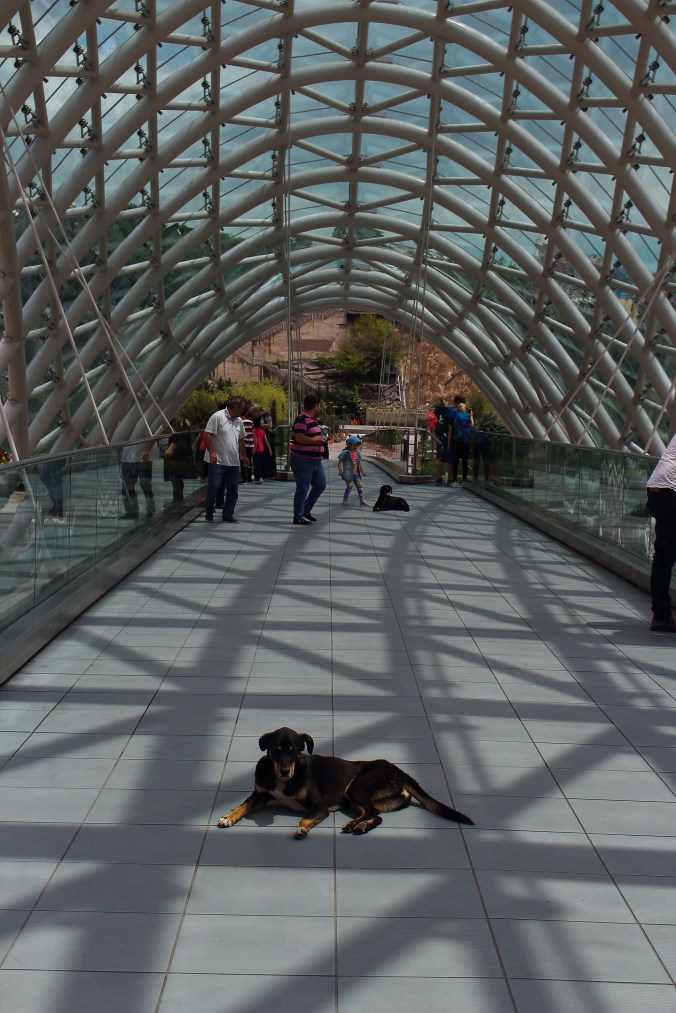
Peace Bridge inside
From speaking with Georgian people, my feeling was that they dislike Mikhail Saakashvili, Georgia’s former president, immensely, and they also dislike things that are associated with him as a result. The Piece Bridge is one of such things; another one is this Music Theatre and Exhibition Hall in Rhike Park, which looks like two massive tubes.
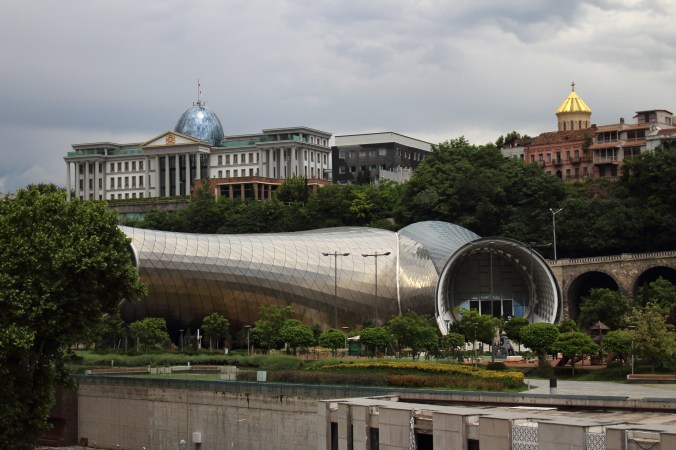
Music Theatre and Exhibition Hall, Rhike Park
We went to Matekhi Church, a beautiful church sitting on a rocky outcrop above Mtkvari. The church was built between 1278 and 1289; it felt very intimate and private inside, and it also struck me that icons look quite different to those I had seen in Russian Orthodox churches — somehow, they looked older and more ‘primitive’.
After that, we wondered around the old town; we stumbled across a big gathering of people enjoying a concert —
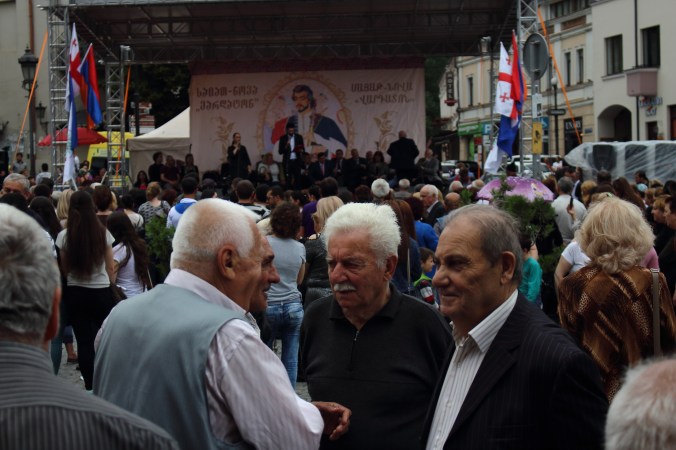
— and went to the Armenian Cathedral of St George, a pretty 13th-century Armenian church in the old town. Here, the atmosphere was very different compared to Matekhi: people were talking, laughing and taking pictures.
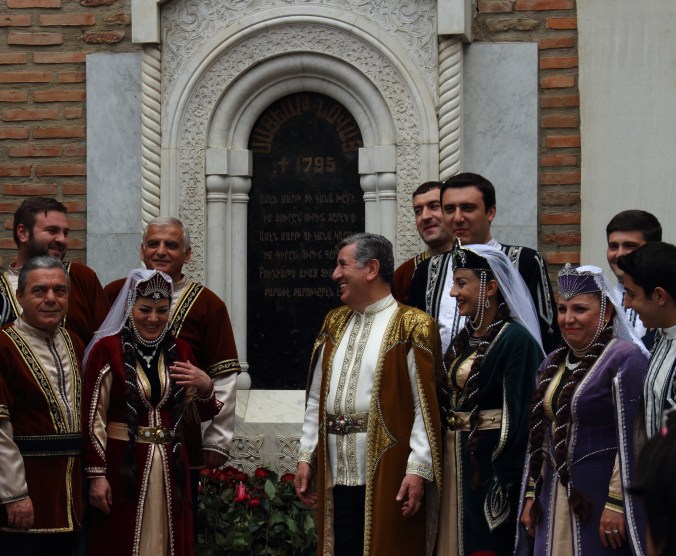
Outside the Armenian Cathedral of St George.
We had lunch in a cheap and cheerful place called Samikitno on Freedom Square. It was exactly what the doctor ordered — we particularly enjoyed aubergine with walnuts and the aubergine salad and — of course! — khinkali. Khinkali are, essentially, big dumplings, and they come with all sorts of fillings: lamb, beef, cheese, mushrooms, cottage cheese… They are succulent and totally delicious! 😍 The one thing on the menu I did not especially liked, however, was gomi, which is made from coarse cornmeal and topped with strips of Sulguni cheese and butter; it was just a tad too bland, and even the Sulguni cheese didn’t help.
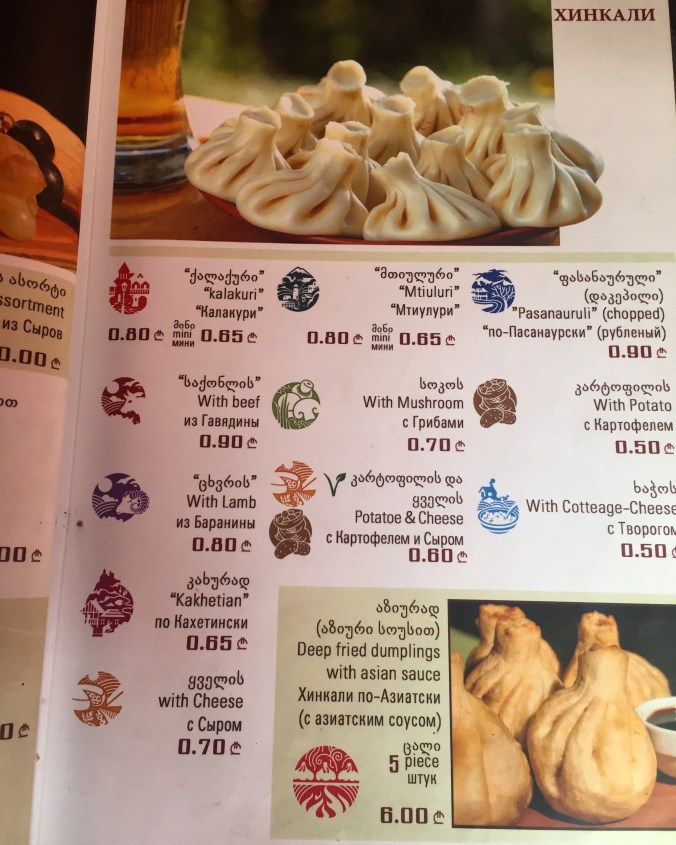
Khinkali at Samikitno
…
In the evening, we went to the opera. The Opera & Ballet Theatre (officially, the Georgian National Opera and Ballet Theater of Tbilisi — formerly known as the Tiflis Imperial Theater) is unusual and impressive. It is a neo-Moorish building with colourful tiles and stained-glass windows inside, which reopened in early 2016.
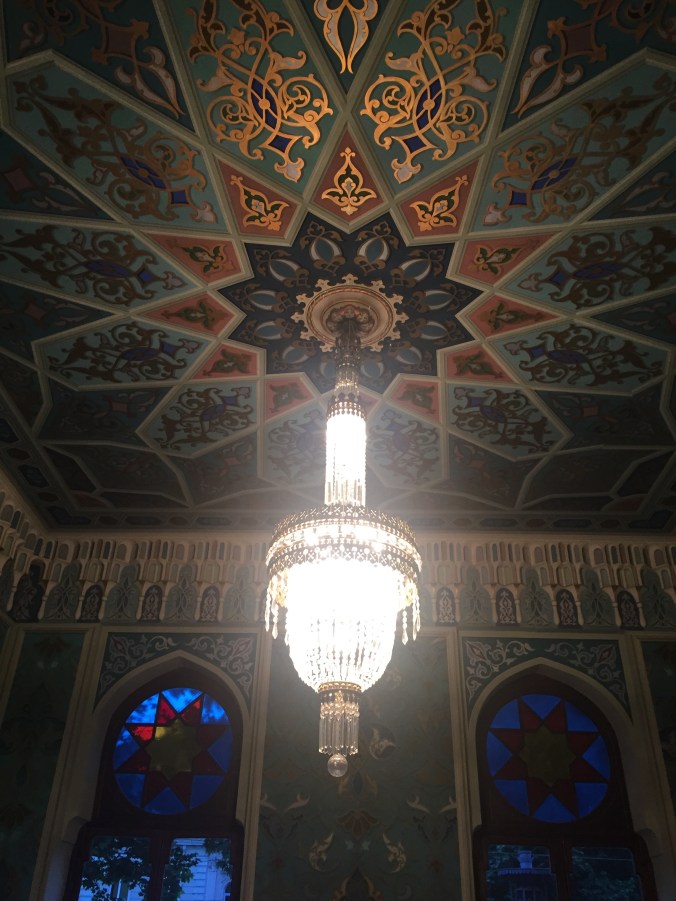
Inside the Opera & Ballet Theatre
We saw L’elisir d’amore (The Elixir of Love), and it was a premiere. The opera was in Italian with Georgian subtitles, and it didn’t particularly help that we didn’t know the plot and were incredibly tired after all of the travelling the previous night. So we started to doze off… It is a very particular feeling when you wake up just as you head is about to land on the shoulder of the person sitting next to you, very embarrassed at your apparent lack of cultural sophistication and hoping that no one has noticed your faux pas. However, we were a lot more awake during Part 2, and got the general gist of the story: the set up was circus (it was all quick-paced and colourful), and the main heroine was choosing between two contenders for her heart, and eventually chose one.
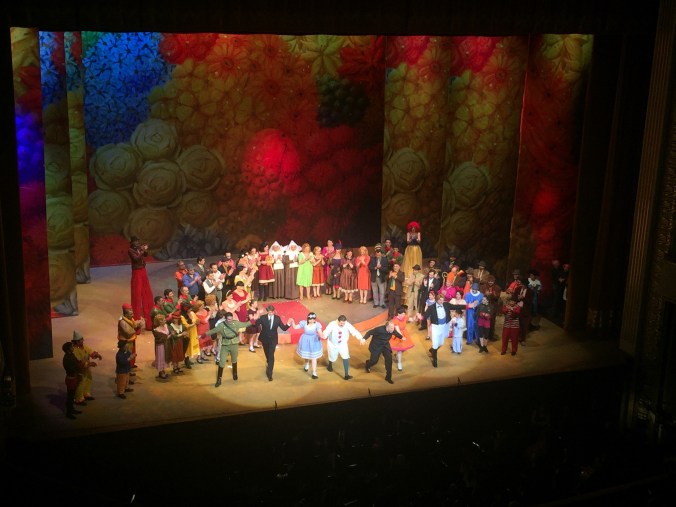
L’elisir d’amore — I think we eventually got the gist of it, even though we speak neither Italian nor Georgian.
I noticed that there were more women than men, and also that women were immaculately dressed; I certainly felt underdressed in my out-of-the-backpack little dress and flats in comparison!
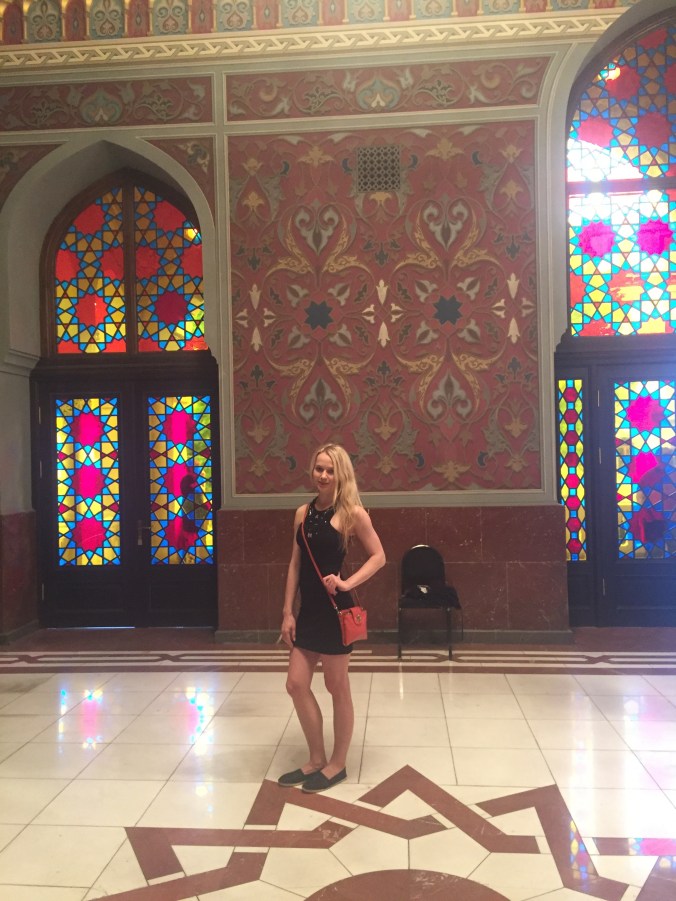
The Opera & Ballet Theatre. Underdressed!
And this is a general tendency among theatre goers in Eastern Europe and the former USSR countries, which just isn’t the case in the UK (with some notable exceptions, like the Royal Opera House). I think it’s nice to dress up when you attend a cultural event and I miss this aspect of social life in the UK. 😏
…
During day 2 in Tbilisi, after our little ‘carbonara confrontation’ with Otta and after Abe finally joined us (😃), we continued our Tbilisi exploration. As all of three of us are great lovers of food (and, in the case of Justina and me, wine), we decided to savour more delicious Georgian food. So we made our way to a fantastic restaurant called Barbarestan, where we had a little Georgian feast.
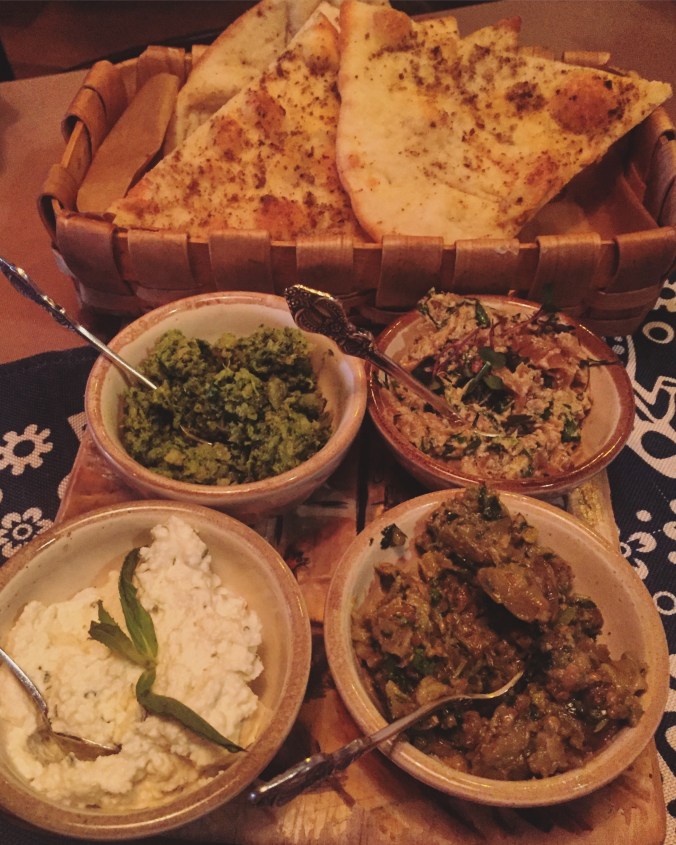
A bit of food heaven at Barbarestan.
After we we were done with the food, the restaurant’s owner came over for a chat. He told us a fascinating story; the story was that he went to an antique market and found a very old book, which was written by “the first feminist of Georgia”, Barbara Georgadze. It was a recipe book, and this was the birth of the restaurant, and up until now, they still use many of the recipes from that book for Barbarestan’s menu.

The mysterious recipe book.

The mysterious recipe book — 1914!
He then took us on a little tour downstairs, to the restaurant’s cellar. He explained that wine in Georgia was made not in oak barrels (like it is elsewhere), but in clay barrels instead. He also told us that Georgia was where wine was born. Later on, when we travelled around Kakheti, the famous wine making region of Georgia, we were fortunate to experience Georgia’s wine making traditions at their finest. 😍
…
We also realised that Tbilisi has a big big problem with pedestrian crossings, which are very few and far between in the city — and, more crucially, Georgian drivers don’t seem to give a monkey’s about them. We were, in fact, told that a number of people die every year trying to cross the road and drivers just drive off… Nice (not). 😬
…
Having refuelled our bodied and minds at Barbarestan, we got a cab to the old town an wondered around some more, and then we took a cable car.
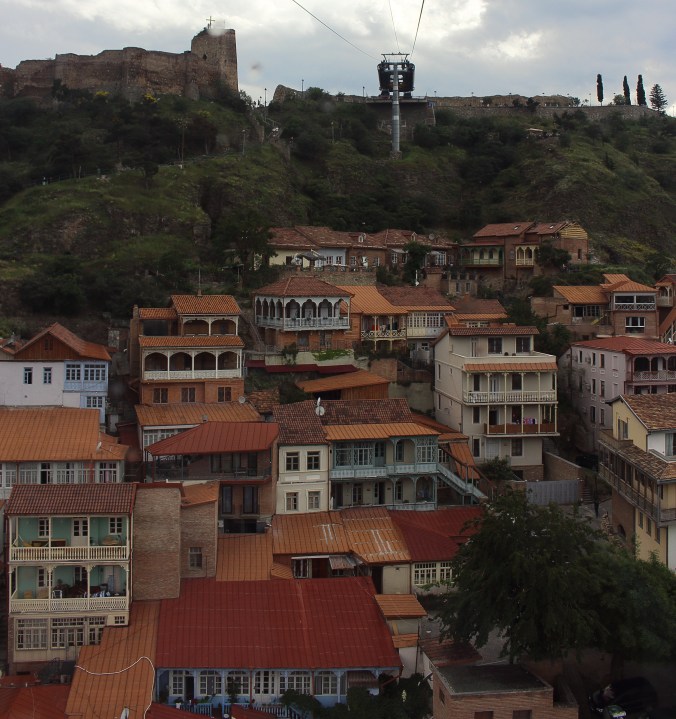
Inside the cable car!
The cable car was opened in 2012 and takes you over the Mrtkvari river and the old town all the way up to Narikala Fortress, which dates back to the 4th century, when it was a Persian citadel. The views of Tbilisi from up there were truly superb. 😍

Tbilisi views
In fact, Tbilisi has both a cable car and a funicular — according to Lonely Planet, my ultimate travel bible (I love travel guides — I am old fashioned like that 🙈), two of Tbilisi’s most exhilarating rides, so we were determined to try out both. Before we got to the funicular, however, we stopped by at Justina’s friend’s place, who was very kind and hospitable to us. We had a glass (or two…) of bubbly in her beautiful apartment, surrounded by her stunning paintings, while she shared with us her stories about Georgia. We ate cheese from the Phoka Nunnery, where nuns make chocolate and cheese, and listened to her in fascination.
We learnt, for example, that the richest man in Georgia is called Bidzina Ivanishvili; he was also Prime Minister of Georgia in 2012-2013 and is still the man behind major political decisions.
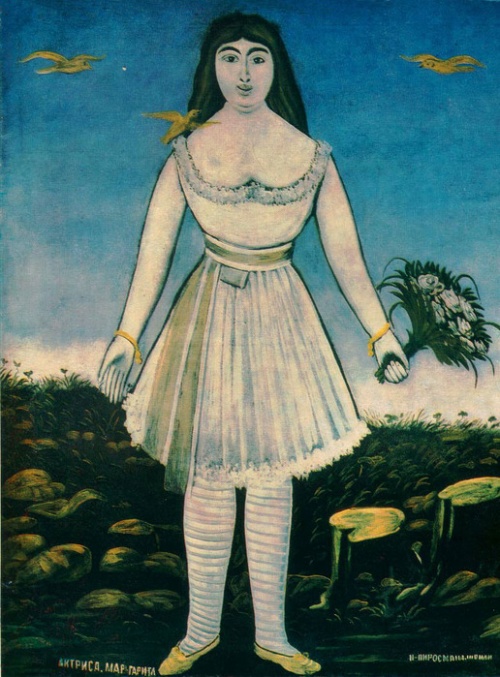
We also learnt a beautiful story behind one of the most iconic Russian songs — although this is actually a bit misleading, because the song was originally written by a very famous Latvian composer, Raimonds Pauls; it was subsequently covered by a Russian singer Alla Pugacheva (there have also been a number of other international covers — inexplicably, Vietnamese, Korean and Japanese singers seem to be particularly fond of it!). Anyhow, the Russian version of the song is called ‘Million Scarlet Roses’, and you can listen to it here. It tells a story of an artist, who fell in love with an actress who loved flowers; he sold all his modest possessions — his little house and canvasses — to buy a million scarlet roses, which he then lay in front of her house, all in a (futile) attempt to win her heart. And so it turned out that this story is based on a true story, the story of a Georgian artist, Niko Pirosmani, who fell in love with a French actress, Margarita, in Tiflis (as Tbilisi was known at the time). More on Pirosmani and his paintings can be found here — and here’s his painting on Margarita:
…
In the evening, we took the funicular up to Mt Mtatsminda, which literally means ‘The Wholly Mountain’. Mt Mtatsminda offers more stunning views of the city and is topped by a 210m high TV tower.
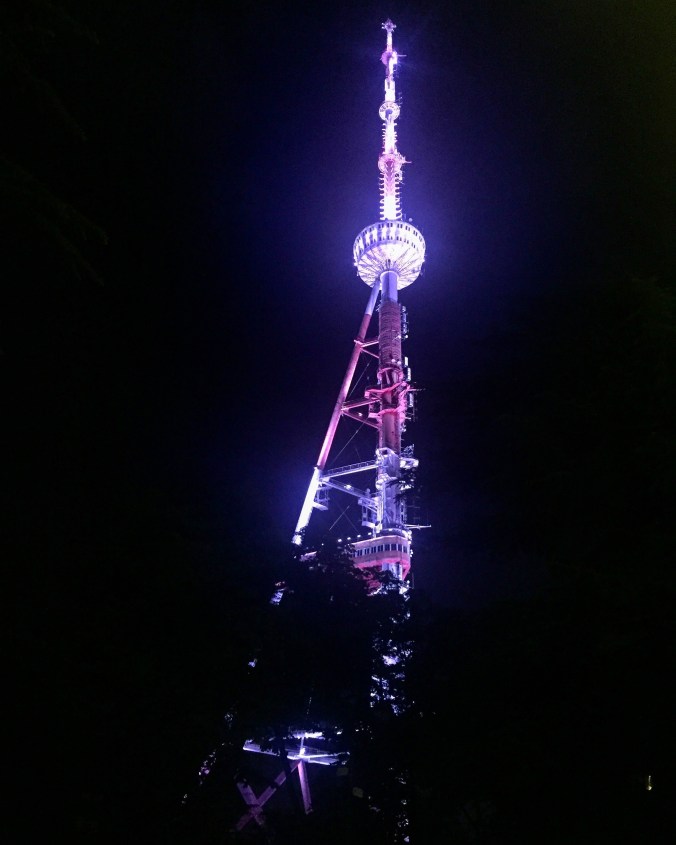
TV tower atop Mt Mtatsminda.
In contrast to the cable car, however, the funicular is much, much older: it first opened in 1905, and was a truly international project: French, Italian, Belgian, Polish, Russian and Georgian engineers, architects and builders were all involved. Interestingly, the original purpose behind the construction of the funicular was a practical one: at the end of the 19th century, the expansion of Tbilisi within the then city limits along the Mtkveri river was difficult, and so it was decided to build ‘Upper Tbilisi’ on Mtatsminda. The funicular was meant to connect the the ‘Upper Tbilisi’ with the existing ‘Lower Tbilisi’.
Now, the real reason we wanted to take the funicular up Mtatsminda that night was because we had heard that Funicular Complex offered the best ponchiki in the history of time (the views came close second!). For the uninitiated, ponchiki are Russian donut holes, and we were really craving some.
…Funicular Complex did not disappoint — whilst it was undoubtedly death by sugar, the ponchiki we had were just divine, so it was all worth it.
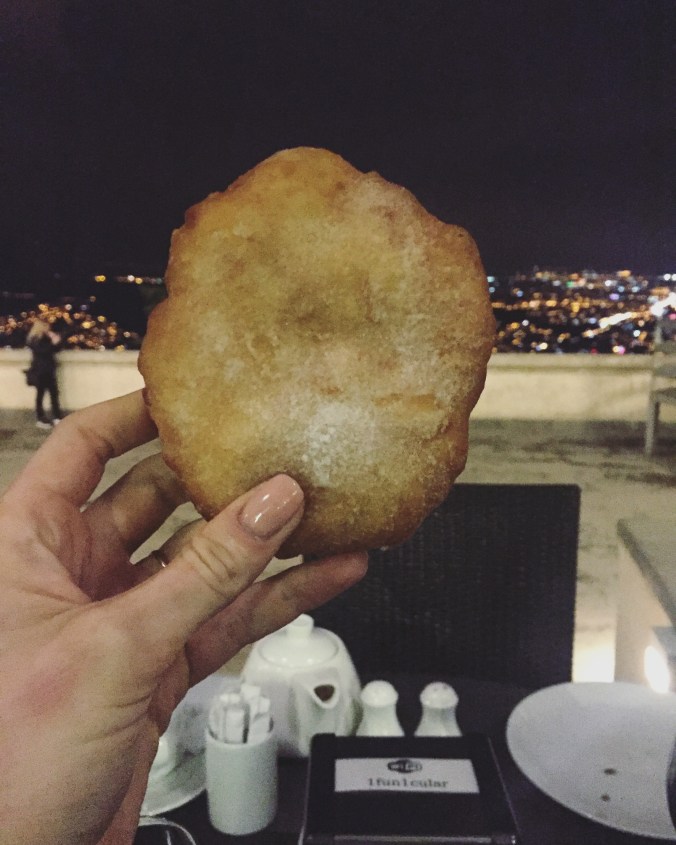
Ponchiki on Mtatsminda — divine!
We also ordered some Georgian wine (of course!) and sat there for ages, admiring the view of the city in flickering lights, drinking Georgian vino, talking about love and life, and eating our ponchiki.

Tbilisi by night, Mt Mtatsminda
And this was the end of our first few days in Tbilisi. 💙


 WIMO
WIMO 