In Part II, I mentioned that Georgi is by far the most common name in Georgia, and that we met many many Georgis, all using different variations of the name, while we were travelling around the country. However, the most important Georgi of our lives was (and remains to this day!) Gigi, who showed us around his beautiful country, shared his stories and raised countless toasts with us, and opened his heart and his home to a funny trio struggling to pin down their geographical origin.
Gigi picked us up from our beautiful run down Tbilisi home on 31 May and we set for Kakheti, the famous wine region in the east of Georgia. It was the Police Officer Day in Georgia, so the traffic was heavier than usual but, once we got out of the city, the road was fast, the conversation flowed and we were admiring the sea of green through which the road was taking us. The hills we drove through were green and luscious, it was a warm day with a glorious sunshine, and, although we hadn’t yet reached Kakheti, it really felt like we were in some wine growing region of Italy — we even passed a sign to a village called “Verona”! Gigi was witty, funny and knowledgeable, and spoke impeccable Russian and fluent English. We talked about all sorts of things — politics (*how the Svan mafia (from the Georgian region of Svaneti) ran everything in the country until 2004, until Mikhail — “Misha” — Saakashvili, Georgia’s (much loathed) former president now hiding in Ukraine, came to power, and his brutal ways), ethnography (*that Georgian surnames ending with “vili” (e.g., Saakashvili) originally come from Kakheti, whilst those ending with “dze” (e.g., Shevardnadze — another former president of Georgia) — from the Georgian region of Racha), culture (*about the famous director Sergei Parajanov, who was born in Tbilisi and whose 1968 film The Colour of Pomegranates is considered by some the best film ever made) and Georgian wine making (*about the ancient Georgian wine making tradition called “Qvevri“; qvevri is a wine vessel made of clay and covered with a layer of beeswax inside, completely buried in the ground).
Qvevri in one of the wineries we stopped by in Kakheti
We honestly could not have asked for a better, more passionate and more knowledgeable person to continue our romance with this mesmerising country. As we drove, Gigi kept playing this song:
It was a beautiful and very philosophical song I had not heard in very long time. It was absolutely perfect for our Georgian road trip.
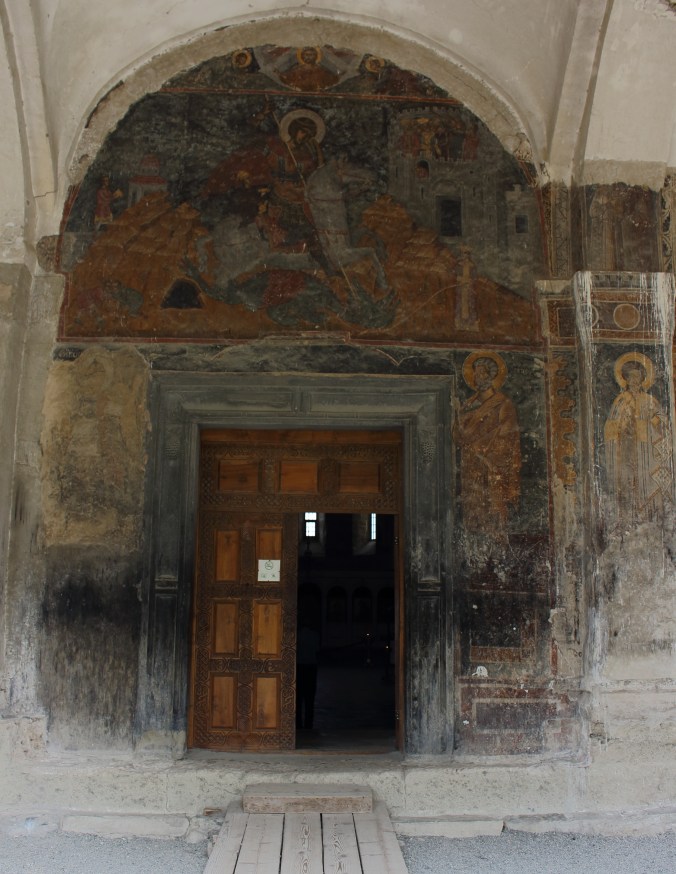
Some time later, we stopped at Alaverdi Monastery. The monastery was absolutely stunning and looked really old — indeed, as I subsequently learned, it dates back to 6th century, when it was founded by the Assyrian monk Joseph. It was made of stone and had high ceilings inside, and its walls, as well as the space above the entrance, were covered by stunning frescoes.
Entrance to Alaverdi Monastery
As we entered the monastery, huge stormy clouds gathered around; there was heaviness in the air and it was dark, which enhanced the mysteriousness and haunting beauty of Alaverdi.
Alaverdi. There was heaviness in the air.
Alaverdi Monastery cat
Petting the monastery cat
One thing we were not too thrilled about was the fact that, although we were dressed conservatively, we were still made to wear a long brown gown (albeit we later learned that this was pretty much customary in the majority of Georgian monasteries). However, on leaving Alaverdi, we got the Georgian sweet churchkhela, which immediately cheered us up. Churchkhela is a funny looking sweet because it looks like a thin long sausage — but it’s essentially nuts threaded onto a string and dipped in grape juice, which is then dried. DELICIOUS. 😋
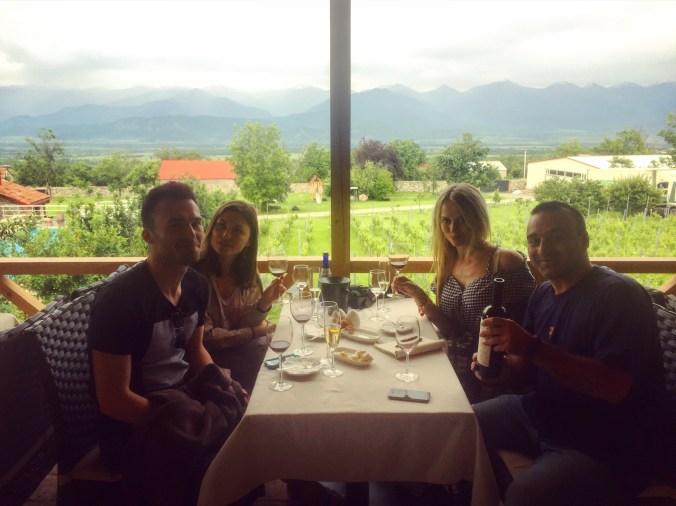
After this rather intense experience, we felt we needed something to lighten our spirits, so we headed straight to the Schuchmann winery for some wine tasting — after all, we were in the country which claims to be the cradle of wine civilisation, and in its main wine producing region at that!
About to embark on some quality wine tasting.
This was another wonderful experience. We tried 7 wines, predominantly qvevri, a mix of reds, whites and sparkling, filtered and unfiltered, and each tasting was accompanied by the most knowledgeable explanation of the process and the business of the winery (it was interesting to find out, for instance, that Schuchmann’s main export market was China, followed by Germany — and not Russia, as I thought).
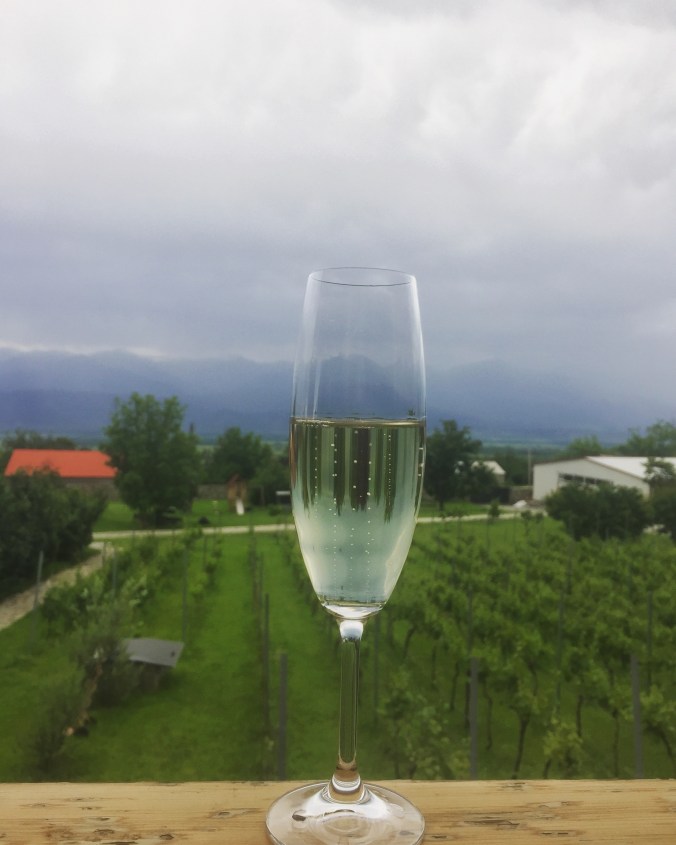
Wine No.2 — cheeky bubbles.
All of the wines were great, but I particularly liked Mukazani, a dry red, and ended up getting a bottle to take back home with me. As we drank our wines, our minds slowly and pleasantly getting fogged by their fumes, we were admiring the vast Alazani valley (c.250 km2!), which our terrace overlooked.
The view
…
Happy and pleasantly intoxicated, we arrived in Sighnaghi, a pleasant little town overlooking the Alazani valley, in the late afternoon. We were staying in a hotel called Galavnis Kari for 2 nights. It was a very pleasant hotel, with really stunning views of green rolling hills.
Galavnis Kari — not a bad view to wake up to!
On arrival, we were greeted by the hotel owner called — no, not Georgi this time! — Iosif, or Joseph, a nice and friendly man with piercing eyes, and his wife. Joseph immediately started telling us about his home wine production, and how we absolutely had to try his wine and chacha — which is Georgian (super strong) grape vodka, made from grape residue left after making wine. We dutifully promised that we would do so later.
We were looking forward to a beautiful culinary experience in the evening — we had a dinner reservation at Pheasant’s Tears (when I first heard the name of the restaurant I thought it was actually called “Peasant’s Tears”… “How grossly inappropriate!”, — I commented 😝), a restaurant and a winery famous for its qvevri wines — which it supplies to the Ottolenghi restaurants in London, amongst others — and fresh organic produce. But before we could indulge in this culinary delight, we had a little mission to complete…
Abe’s birthday was coming up, and Justina and I decided we wanted to get him something Georgian. “A traditional Georgian hat!” — we concluded, and without further ado, went hat-shopping around Sighnaghi.
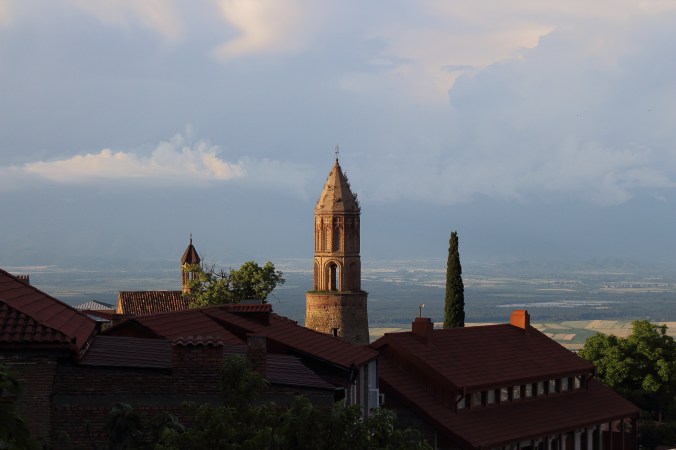
Beautiful Sighnaghi
Sighnaghi, with Alazani Valley in the background
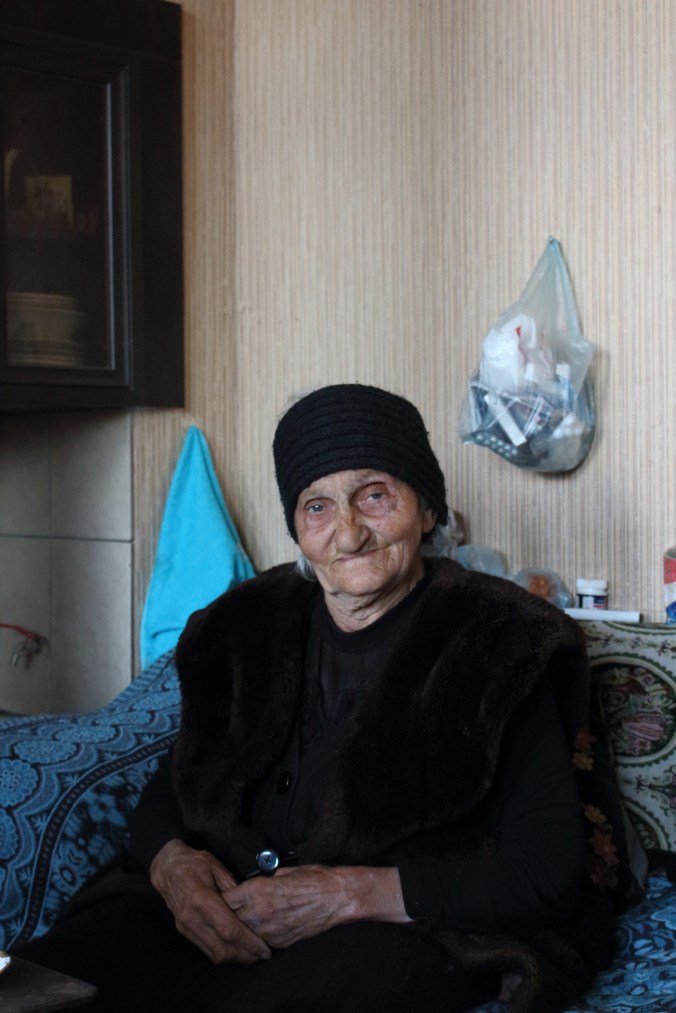
We agreed in advance that we would definitely haggle; after my Central Asian travel experience a few years earlier, I felt I was well-equipped with sophisticated haggling techniques. On one of the main streets, there were some houses with hats and other Georgian things being displayed outside. We stopped by one of those houses and started examining one of those big fluffy Georgian hats which took our fancy. We liked it and decided we would ask for a 10 lari discount. Then, all of a sudden, this old lady appeared out of the house. Her back was bent and she couldn’t stand straight. She had the most amazing blue eyes.
It was immediately clear to both of us that all our haggling plans went right out of the roof. The old lady invited us inside her house and showed us around; it was a traditional Georgian house with lots of icons. She couldn’t speak Russian, nor English, but she told us her name was Sira. We thanked her for her hospitality and bought the hat.
Sira
That evening in Pheasant’s Tears, we were treated to a wonderful meal — we had lamb, which was incredibly mild and tender, the most fragrant cucumber and tomato salad, and other Georgian delicacies. We also drank wine, lots of it. In the process, we got talking to one of the restaurant owners and his wife. We chatted about their friendship with Ottolenghi and the rising chef star Olia Hercules, who apparently came to Pheasant’s Tears in search for an inspiration for her new recipe book. The lady told us that she was a little disappointed that that people didn’t seem to get the traditional Georgian wine which, by her own admission, “takes a bit of self-education“. It is quite heavy, and it takes time and patience to learn how to appreciate it. She said that, unfortunately, people in Eastern Europe and Russia like “easy” Georgian wines, the likes of your traditional semi-sweet Khvanchkara and Kindzmarauli. She said they went to Riga a few times to try to tell people about more exquisite Georgian wines, but it didn’t take off. She seemed quite sad about it. Once again, we saw how much Georgians loved their wine and what great pride they took in it.
At Pheasant’s Tears
Over dinner, many toasts were raised, primarily by our Georgian friends. Georgian toasts are punchy, poetic, allegorical and philosophical all at once. This is perhaps best exemplified by the following toast about a “small, proud bird” from the cult film “Kidnapping, Caucasian Style”, found here and translated as follows: “Once upon a time there lived a small, but very proud bird. She said, ‘I will fly away alone right up to the Sun!’ The bird began to rise higher and higher but soon she burned her wings. Then she fell down to the bottom of the deepest canyon and died. So let’s drink for each of us to stay together as a team!” (source: http://russiapedia.rt.com/of-russian-origin/tamada/)
Gigi raised a toast “to Georgia, a small country with big aspirations” (which for some reason reminded me of the “small, proud bird” toast) and, to finish off the evening — a toast “to beautiful girls — like you“. That toast we liked very much. ☺️
We returned to our hotel tired and happy. Joseph was waiting for us at the entrance. He was very insistent that we should come with him and try his home made wine. We declined, and Joseph was seemingly upset. We felt sorry for Joseph but there was no way we could drink more wine that night.
…
The next day was the hiking day. At the trip planning stage, we were all keen to incorporate a bit of hiking into our Georgian adventure, and were wavering between Vashlovani and Lagodekhi Protected Areas — albeit very different, both looked spectacular. We eventually decided against Vashlovani, however, due to the likely presence of vipers 🐍 (see Part II!). You can do a long hike in Lagodekhi to Shavi Kldeebis Tba a.k.a. Black Rocks Lake, which looks spectacular, but we didn’t have 3 days to spare, and instead opted for a shorter half-day hike to two waterfalls. Gigi was going to wait for us at the entrance. We met Gia (which is yet another variation of the name Georgi!!), one of the local guides, at the visitor centre, who explained that we needed to follow yellow signs to the waterfalls. Sounded easy enough! My Lonely Planet guide also informed me that Lagodekhi was “home to several hundred East Caucasian tur, deer and chamois“. As we were to find out just a little later, Lonely Planet failed to mention one very big fury animal. 🙀
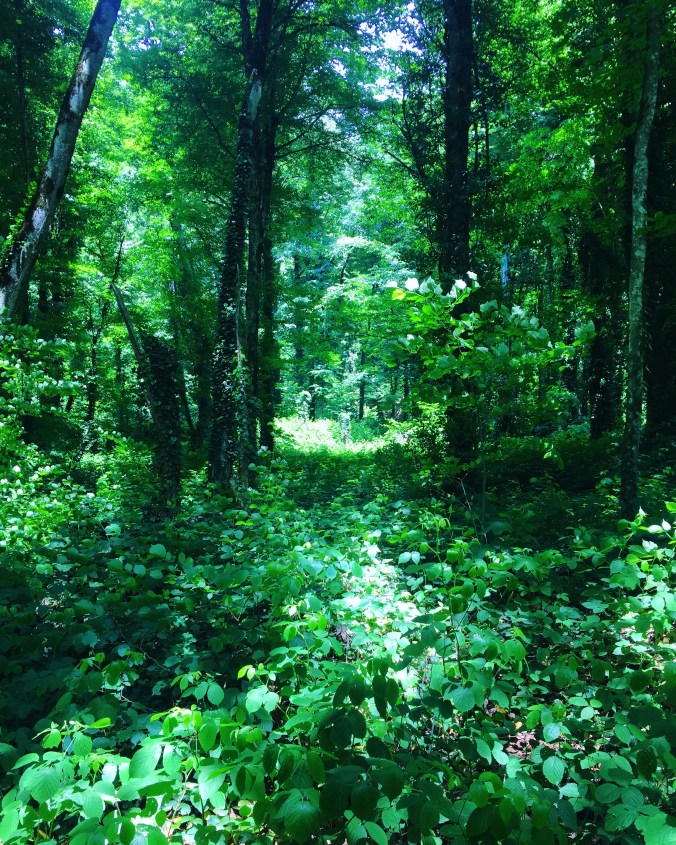
Lagodekhi — start of the hike.
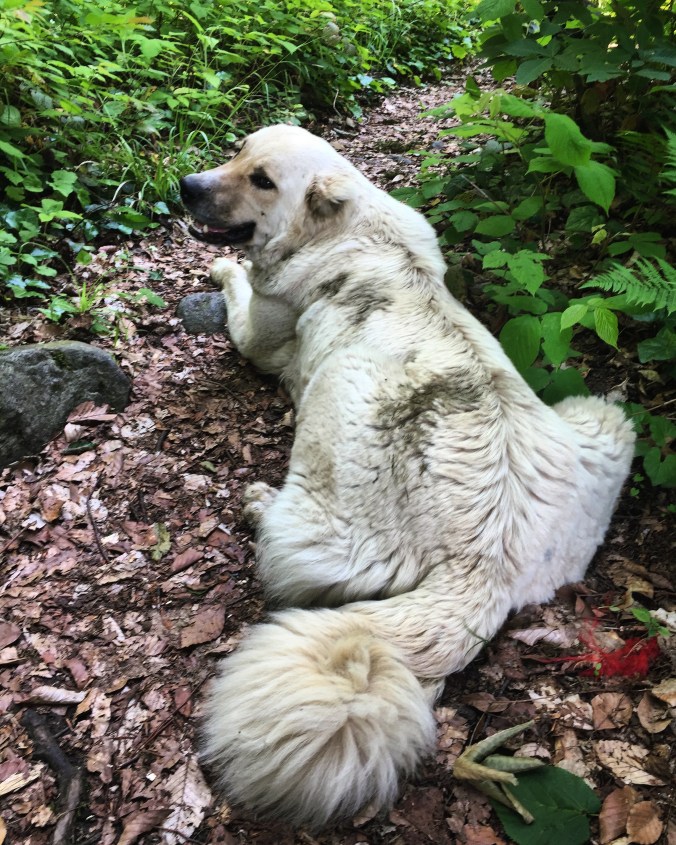
As we progressed down the path thorough the green forest, a cute little mongrel started following us; a big white dog, which looked more like a bear than a dog, also followed us for part of the way. There were very few tourists around, which was excellent.
One of our furry friends
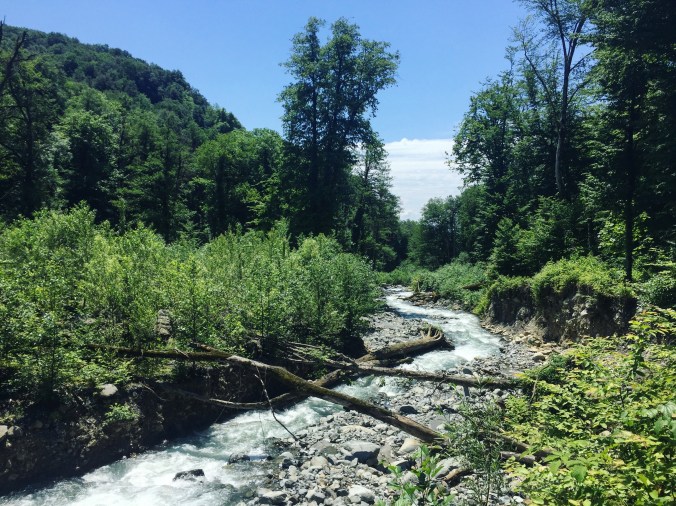
After some time, we got to a small river, quite narrow and shallow but very fast and freezing cold, which we needed to cross.
The river
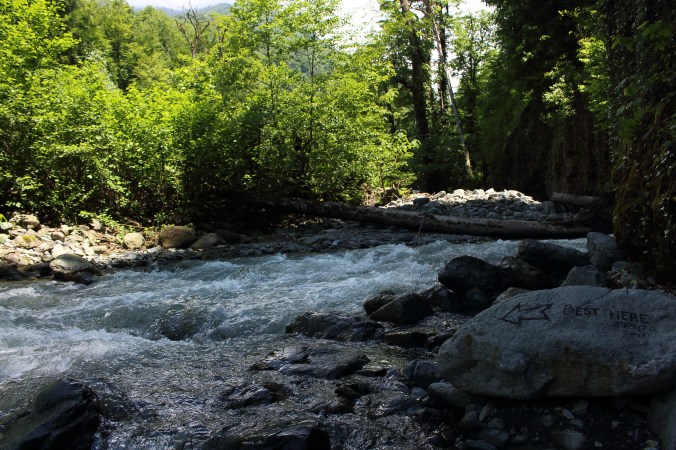
No bridge or other crossing facility was in sight.
No bridge in sight — but thanks for the “best here” tip!
So we took our boots off and crossed the river barefoot, sharp stones on the river bottom cutting into our feet. Once on the other side of the river, I heard a plaintive cry. It was the mongrel, left behind on the other side. I couldn’t bear it. Despite my friend’s protestations, I crossed the river again, picked up the whining dog and carried it across.
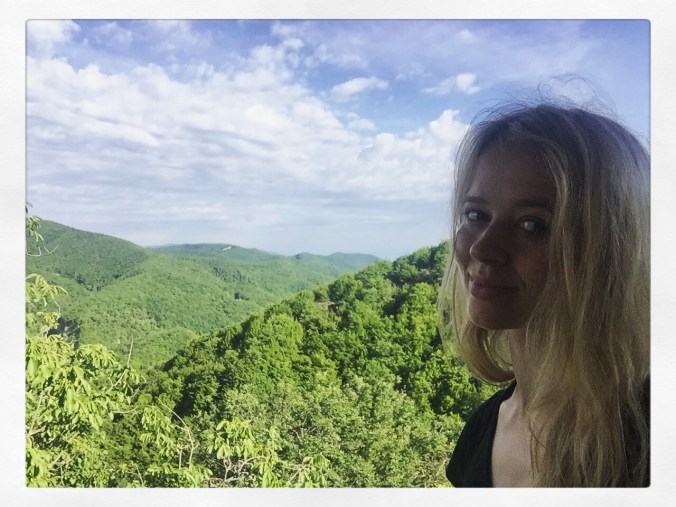
The path kept climbing up higher now, and the river was down below. It was still very foresty and quite steep. And then, out of nowhere and entirely unexpectedly, three bears appeared: one mamma bear and two cubs, some 10-15 metres away from us! 🐻🐻🐻Before we could react, they ran up the mountain and disappeared out of sight. It was the first time we saw bears in the wild and we didn’t know what to do and whether it was safe for us to continue. We thought that perhaps the mamma bear would feel that we are threatening the cubs and attack us. So there we stood, glued to one spot, not knowing whether to proceed or to turn back. I called Gia to explain the predicament — he was confident it was safe for us to proceed. So we eventually did, and reached the waterfalls with no further emergencies some 10 minutes later. It was a great spot for a leisurely lunch.
We then returned to the starting point the same way, repeating the whole “carry-the-dog-across-the-river” business again. 🐶
…
After another over the top dinner, this time in Nikala in Sighnaghi (where Gigi ordered 15 khinkali, in addition to everything else we had; in response to our protestations, he said this was nothing: the custom number of khinkali for a Georgian party is 300), we succumbed to Joseph’s invitation to try his home made wine.
Gigi’s khinkali
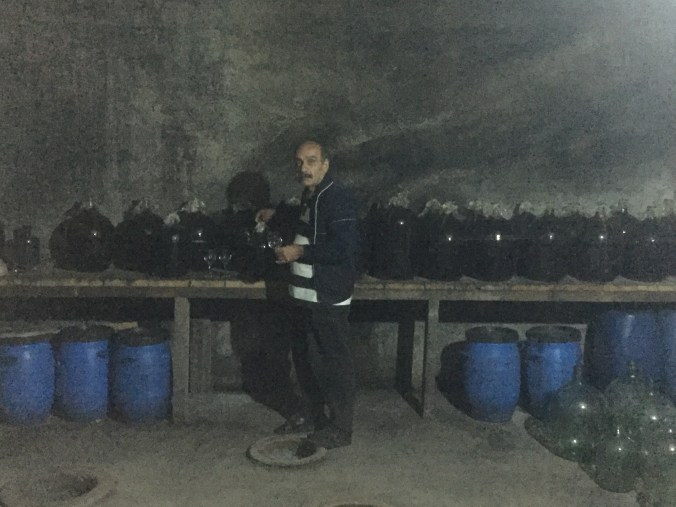
We were terribly tired and already had quite a bit to drink at Nikala, but we just couldn’t say “no” to this man’s hospitality again. So he took us down to his cellar, where he showed us his wine barrels and his chacha machine.
Joseph and his wine
We drank Joseph’s home-made wine, and many toasts followed in succession, including “to friendship” and “to love” — on the subject of which, Gigi and Joseph told us that Sighnaghi was “a city of love”.
“Why?” — we asked.
“Because the registry office here is open 24/7!” — they replied.







 WIMO
WIMO 