Day 3 of our Georgian adventure was dedicated to visiting a monastery. If I had to pick 3 simple words that encapsulate the essence of Georgia, I think it would be: monasteries, wine and food; indeed, from what we saw during our trip, the very many Georgian churches and monasteries are some of the oldest and best preserved I have seen anywhere. I think the fact that Georgia was spared Nazi invasion during WWII must have played a part.
The monastery we visited was that of David Gareji, which is more accurately described as a ‘monastery complex’ as it comprises 15 monasteries spread over a large area right on the border with Azerbaijan, in the Georgian region of Kakheti. Of the 15 monasteries, visitors typically see two: Lavra and Udabno. For history geeks like me, Lavra was the original monastery, which was founded by David Gareji, one of the 13 Syrian fathers who returned to Georgia from the Middle East to spread Christianity in the country in the 6th century. The complex gradually expanded, but in 1265, it was destroyed by the Mongols, then revived by George V the Brilliant (what a name! George V the Brilliant was King of Georgia who recovered Georgia from a century-old Mongol domination), then destroyed again in 1615, when the soldiers of Shah Abbas of Persia killed 6,000 monks.
A trip there took us around three hours from Tbilisi (if you are considering visiting David Gareji from Tbilisi, look no further than Gareji Line — a well-organised and comfortable minibus will take you there and back for a very reasonable price).

On the way to David Gareji, picture-perfect Georgian plains 😍
During the Soviet days, the monastery was used for military exercises; however, since then, Lavra has been restored and is now inhabited by monks (although we only saw a couple when we were there).
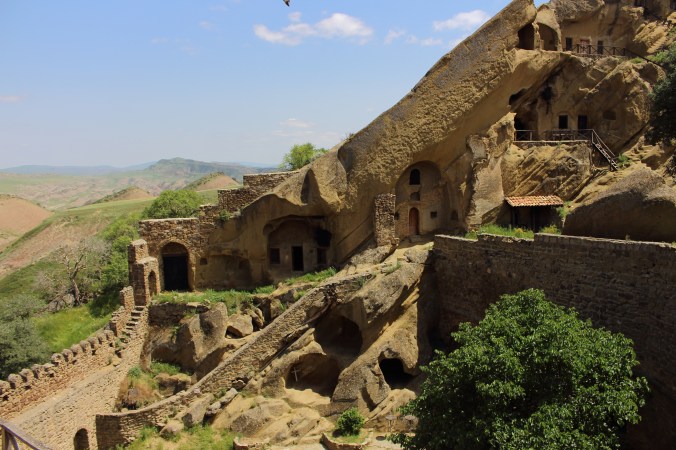
Lavra
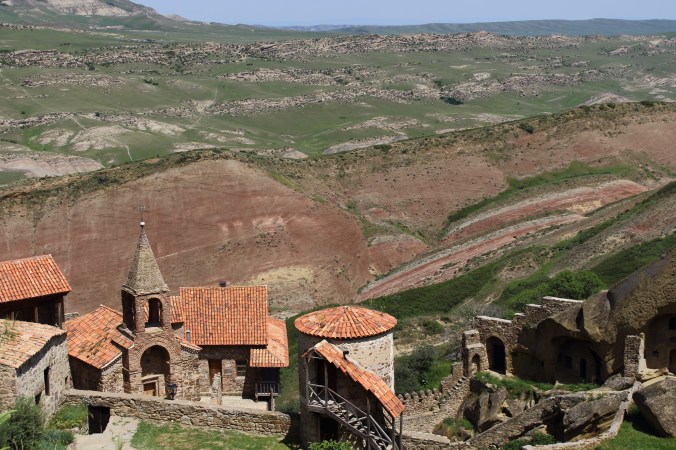
Lavra 2
Lavra is nice, but what I was most impressed with was Udabno. Udabno was quite a hike away from Lavra — had I known, I would have worn something more hike-y than a long skirt and a pair of white Converse!
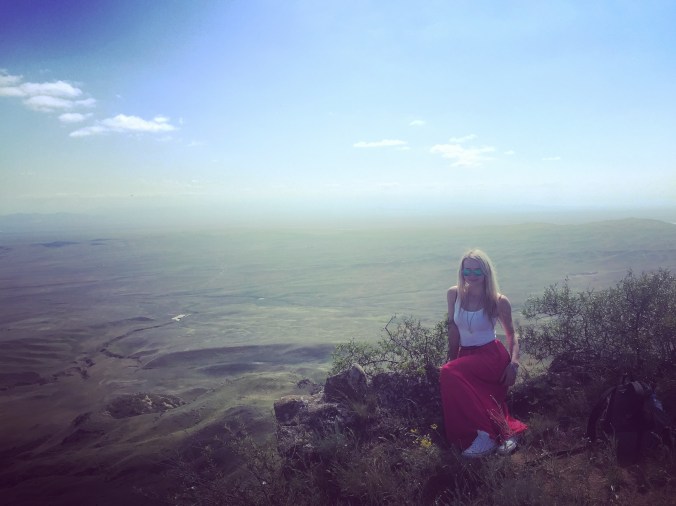
Hiking attire fails 💁
Udadbo comprises a number of caves along a steep escarpment facing Azerbaijan.
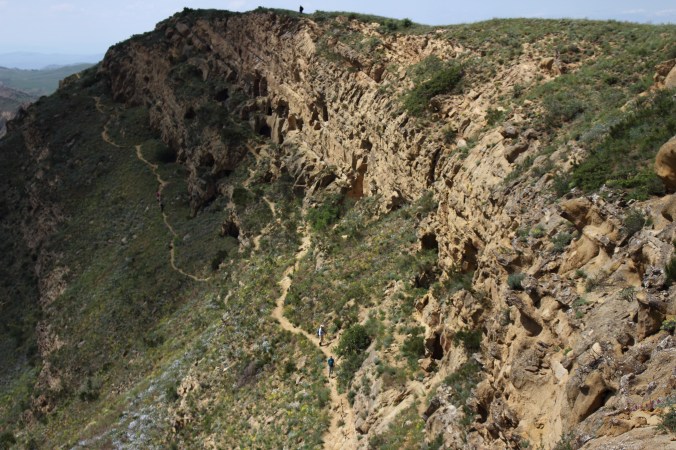
Udabno caves
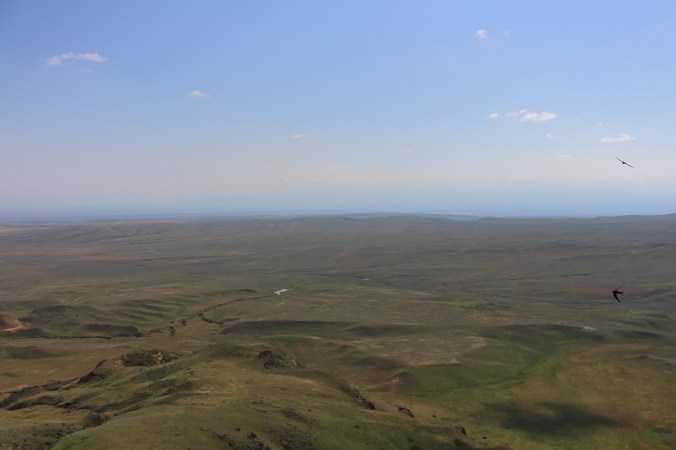
View from Udadno, Azerbaijan. Birds flying high…
Inside the caves, one finds beautiful frescoes — which are even more impressive if you take into account the fact that they were painted in the 10-13 centuries.
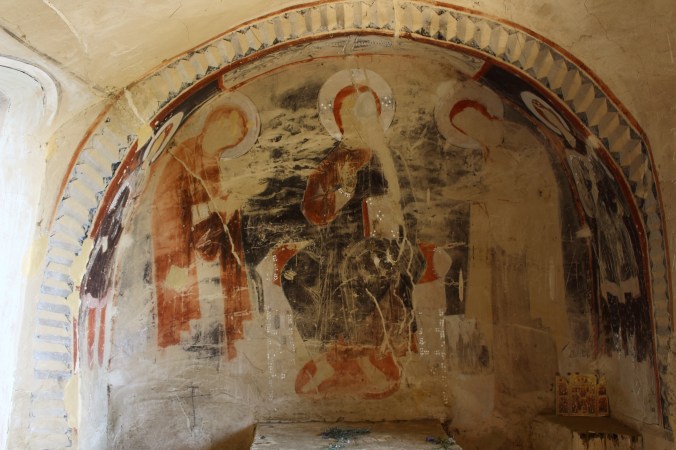
Udabno frescoes
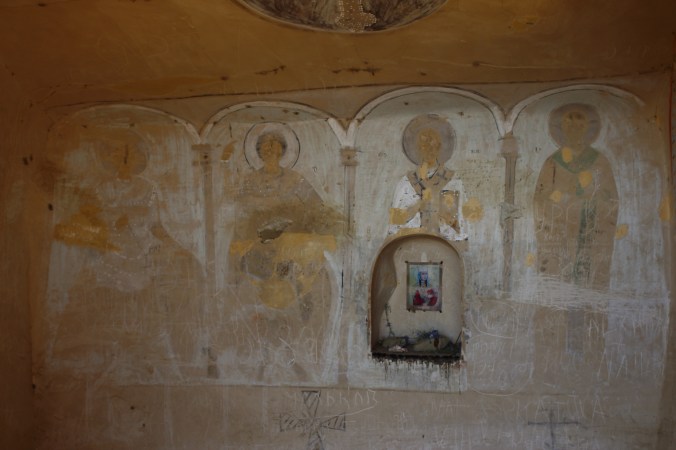
Udabno frescoes 2
Given that these frescoes are so old and so historically significant, I found it remarkable that that visitors were free to wonder around, there were no ‘cave attendants’, and that the entry to the monastery was completely free.
Atop the mountain on the side of which the Udabno caves were sat 2 Georgian soldiers with riffles. They were friendly but politely declined our request to take photos with them; however, I succeeded in sneakily taking a snap of one of them against the background of the green plains of Azerbaijan.
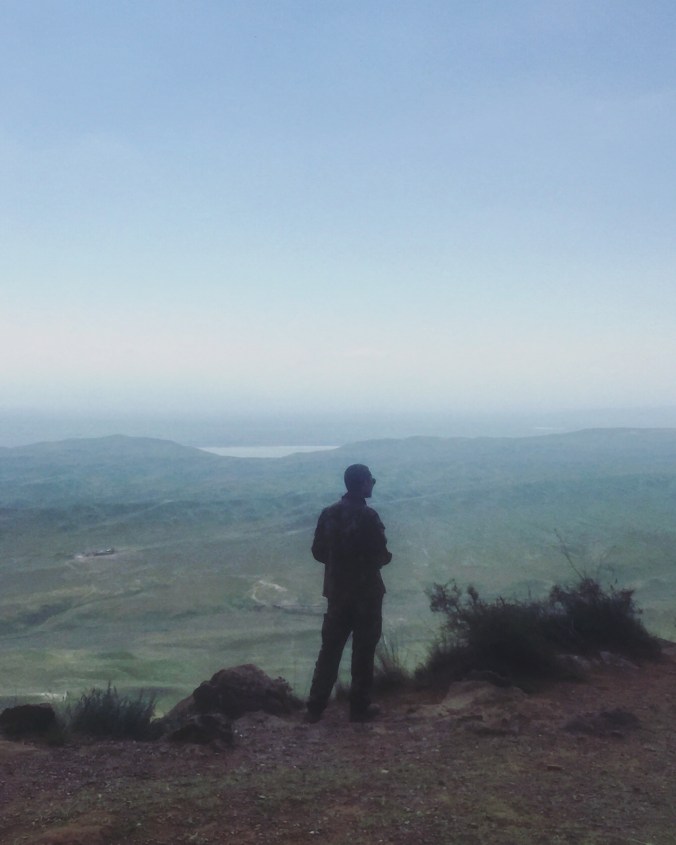
Georgian soldier, David Gareji
The Azerbaijan-Georgia border line has not yet been finally demarcated here, and apparently border tensions occasionally flare up. But, whilst we were there, “[a]ll [was] Quiet on the Western Front“.
One of the main concerns we (read: Abe) had on the way to David Gareji was VIPERS. (This was not entirely unsubstantiated, given that, at the trip planning stage, we were advised against going to the Vashlovani national park by a Georgian on the basis that there was a high likelihood that we would be exposed to a viper attack 🐍! Apparently, May / June is a mating season for snakes and they become quite aggressive. Speaking of snakes, there is a particular type of vipers present in Georgia: Macrovipera lebetina (commonly known as ‘blunt-nosed viper’ and ‘Levantine viper’) — now, these guys must be truly terrifying, with female reaching 150cm in length!) In the event, however, no vipers presented themselves. The only reptiles we saw were a few geckos — including this one —
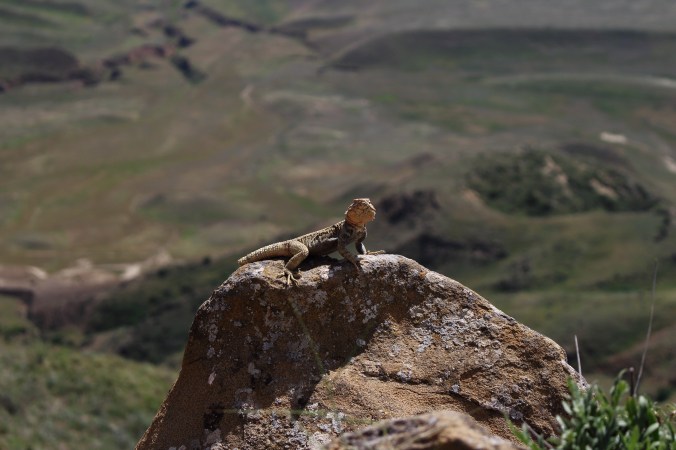
— and, as we were leaving David Gareji, this cute little tortoise lurking in the grass:
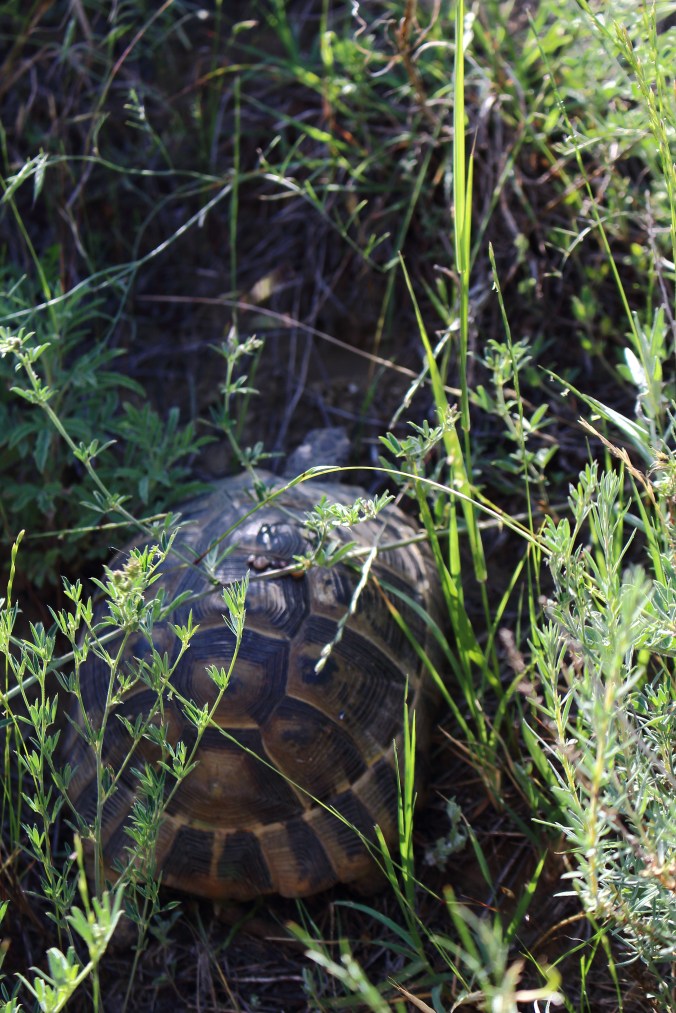
…
We returned to our Tbilisi base around 8pm, having spent just over 3 hours in the monastery.
Abe left us to forge ties with the local music community, and Justina and I made our way to Fabrika. Fabrika is certainly worth a visit if you find yourself in Tbilisi and fancy a bit of a cool vibe — it comprises several bars and concept stores, and has a backyard where young Georgians hang out. It would not look out of place in Berlin, East London or Copenhagen (Fabrika is also a hostel — if you need a roof over your head in Tbilisi!). As the name suggests, Fabrika used to be a factory — a sewing factory, to be precise, and apparently vintage clothes that were once produced by Fabrika can still be bought here under the label ‘Nino’.
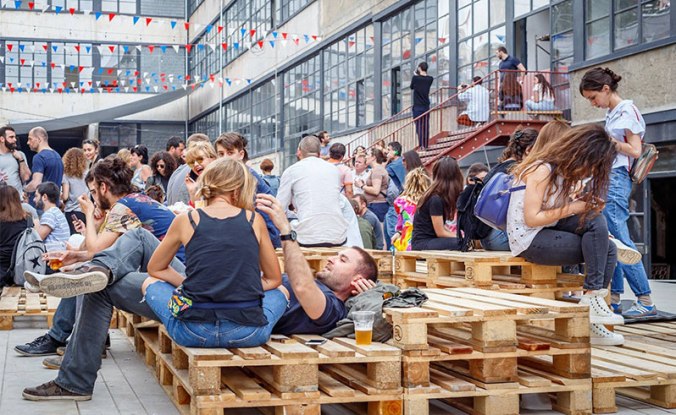
As we were sipping our Georgian wine, we got talking to Goglik. I think — in fact, I’m 99% sure — that ‘Goglik’ is a variation of ‘Georgi’, and Georgi — unsurprisingly, perhaps, given that it’s Georgia we are talking about! — must be the most popular name in the country. We met many Georgis during our time in Georgia; most of them used a different variation of the name, probably to make life a bit less confusing for everyone. But the most wonderful Georgi we met was Gigi, our driver and tour guide around the Kakheti region, who also became our friend in the process. But I digress — this Georgi, Goglik, told us that he was a sound producer. He told us that he did music for one of the scenes in the film “Ben-Hur”, and he was very upset because his name did not appear in the film titles. This did not seem very fair to us 😠.
Having chatted to Goglik for a bit about his misfortunes, we headed back to our flat. In Part I, I wrote about neighbours sitting outside under an awning, drinking home made wine and playing Russian draughts; when we returned home some time after 11pm that night, that was still very much the picture. We greeted our neighbours as we passed by, and the man who delivered red wine to us on our first day asked us when we were leaving.
“Tomorrow,” — we said.
“I will give you some home-made white wine for the road,” — he said, and added: “razum poteryaete” (which literally means: “you will lose your mind“).
We politely declined. We still had 1/2 litre of the red wine he previously gave us, and did not want any wine to go to waste as we would most certainly have neither the time nor the stamina to drink it before tomorrow, when we had to depart for Kakheti. He appeared to accept it but, some 5 minutes after we got back to our flat, the door bell rang.
“Who is that?” — I asked, with slight trepidation.
“Mamuk,” — a deep voice responded.
I opened the door, and there he was, our lovely neighbour Mamuk, smiling, arms stretched out with two bottles of white wine.
“This is very kind of you,” — I said, — “I don’t know how to thank you”.
“No need to thank me,” — Mamuk replied, — “Just come to Georgia again”.
Have I said already that the Georgians are one of the kindest and most hospitable people I have ever met..? 💙
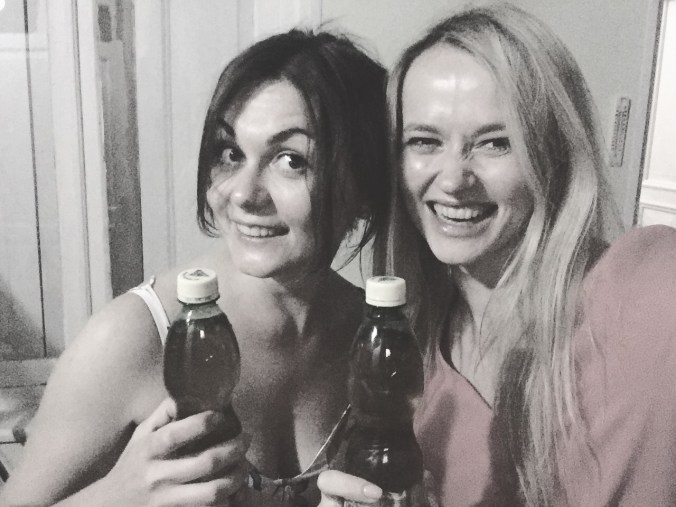
With Mamuk’s home-made wine
The next morning, we left for Kakheti, the famous wine region of Georgia.
 WIMO
WIMO 