“Lovest thou mountains great,
Peaks to the clouds that soar,
Corrie and fell where eagle dwell,
And cataracts rush evermore?
Lovest thou green grassy glades,
By the sunshine sweetly kist,
Murmuring waves and echoing caves?
Then go the the Isle of Mist.”
Alexander Nicholson, The Isle of Skye
xxx
We crossed the Skye Bridge to the Isle of Skye, Scotland’s second largest island, with a population of 10,000.
It is said that Skye takes its name from the Norse word skuy (“misty isle”) — alternatively, skýey or skuyö (“isle of cloud”).
Our plan was to spend 2 nights and one full day on Skye, staying with a local family we found on AirBNB. Amusingly (again, only in Scotland!), the directions for the place we received were by reference to cattle grids: get to Hebridean Hotel in Broadford, take the road to the left and count kettle grids as you keep driving: you need to count exactly four (if you’ve counted more than four, you’ve gone too far); after the fourth one, take the road to the right, and you will get to such and and such settlement, and see the house of such and such description on your right.
We diligently followed the instructions and counted the kettle grids, but, despite our best efforts, after the third kettle grid we found ourselves on a private land of some Scottish farmer. The Scottish farmer was friendly but a little suspicious of us. Meanwhile, my driver became nervous and frustrated (as he frequently does when he gets lost on the road), and after some circling around in an attempt to find the right turn, I made the executive decision to go back to the starting point, to Hebridean Hotel. And so we went back and started afresh, one-two-three-four cattle grids, and this time it worked.
…
The house we were staying in was a beautiful countryside house with stunning views. And it was owned by a very friendly family, who were very kind to us during our stay: Joanna, the lady of the house (and, it seemed to me, the “neck” of the household), her husband and their son. The house had a great fireplace, which warmed not just your body, but your soul. Most crucially, however, the house had a big black dog, a black labrador. As soon as we paid attention to her, she turned into a small puppy, running and jumping around, rolling on the floor and asking to be petted — and she maintained this adorable behaviour throughout our stay. The dog was 4.5 year old but she was one of those dogs that never grow up — always a puppy in spirit, stuck in the ever ageing body. I once knew a dog who possessed the same youthful spirit, but he was quite a bit older at the time — 12, to be exact, and it was a little sad because all he wanted to do was to play around but his back legs had started to give way. It was a little heartbreaking. But, anyway, this dog was still young, and so she could indulge in all the playfulness and foolishness in the world her heart desired.
That night, we went out for dinner to what appeared to be the only restaurant in Broadford, Cafe Sia. The food was decent enough, but it took a while to arrive because the place, which was seizable, was only not very well staffed: we only saw two waitresses, and the poor girls appeared quite stressed as they were whooshing around the place, trying to deal with competing demands of many hungry customers.
J kept himself entertained by pulling faces while we were waiting for our food.
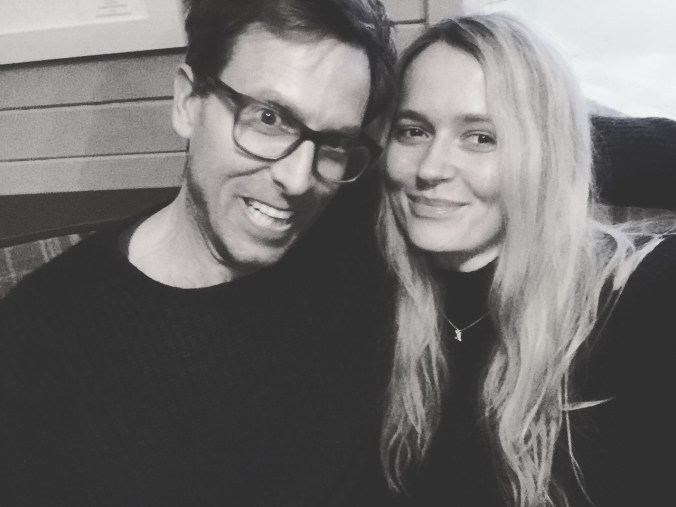
When you discover that your travel companion is crazy but you are in a remote place is Scotland and have nowhere to run.
After the dinner, we drove back to our cosy temporary home, where whiskey by the fireplace awaited us. We chatted for a bit with our hosts and their two American guests. Joanna told us that sometimes a deer would wonder into their garden — a deer! just like that! — and then get its antlers stuck in something; it would then try to break free and lose its antlers in the process, and she would wake up to a pair of antlers in her garden.
We did not wake up to a pair of antlers next morning, but to these beautiful views instead:
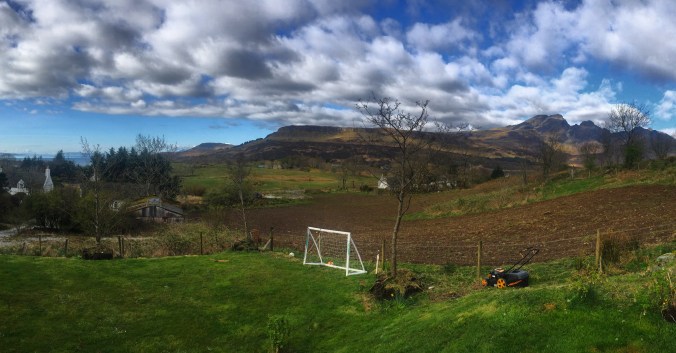
At 8am, we were given a very delicious and nutritious breakfast and devised our plan of action for the day. Joanna told us that from her — extensive, as it turned our — hiking experience, one of the best hikes was up Blà Bheinn (Blaven), which incidentally happened to be only a short drive from Joanna’s place.
Blà Bheinn is officially a Munro. In case you, like us before, haven’t a clue what a Munro is, here’s a (very) brief etymology. At the end of the 19th century, this gentleman, Sir Hugh Munro, a Scottish mountaineer —
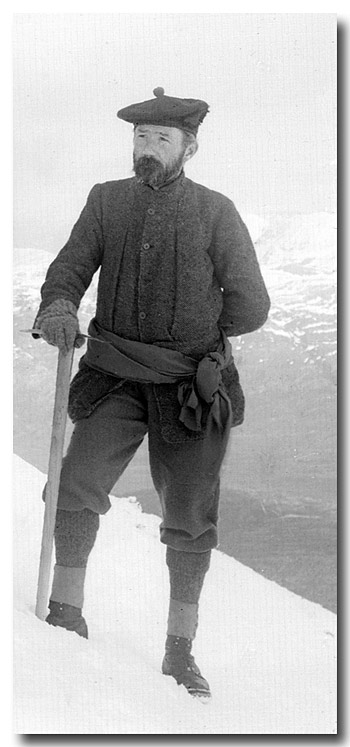
Source: http://www.smc.org.uk/
— compiled a list of all Scottish mountains measuring over 3,000ft (914m) in height. His name has since come to denote all mountains in Scotland over 914m, of which there are 282. Munro bagging is a national sport in Scotland, and Munro baggers are hikers who attempt to climb — bag — all of the Munros. Once you have, you are entitled to be called a Munroist: apparently there are over 5,000 of them. Joanna told us that she had bagged 99 Munros to date. (Smaller hills in Scotland also have funky names: hills of 700m with a drop of at least 150m on all sides are called Corbetts, hills over 610m — Donalds, and baby hills over 90m — McPhies.)
Blà Bheinn is 928m heigh and possible meanings of its name are Blue Mountain, Warm Mountain and Mountain of Bloom. It is part of the Cuillin— a range of rocky mountains on Skye (also known as the “Black Cuillin”, to be distinguished from the “Red Cuillin”, which comprises lower and less rocky hills).
The hike was only about 8km return but took us nearly 6 hours to complete. According to Walking Highlands, Blà Bheinn’s “ascent is straightforward by Cuillin standards”, but we did not think it was straightforward at all. When J and I discussed the hike afterwards, on the basis of our combined hiking expecze, we assessed the level of difficulty to be 7/10. Had it been a longer hike and in higher altitudes, it would have been really rather challenging.
What made the hike difficult was a combination of the following things: (i) a complete lack of signposting; (ii) quite a steep assent when we reached the last leg of the hike; and (iii) an abundance of gravel, which meant you had to concentrate and choose your step carefully; this made (ii) even more difficult.
Luckily, (i) was quickly resolved, when half an hour or so into the hike, we met a lovely pair of fellow hikers, a local man and his daughter, who was over for a visit. They ended up being our guides as the man had done this hike before.
About 20 minutes before we reached the top, there was a quite a big rock we needed to get on top of to continue. J kindly offered to give me a “boost”. However, J must have underestimated that, being the fit girl that I am 😜, I already have sufficient strength in my upper body. I pushed myself up with my arms, which, in combination with J’s “boost”, resulted in me landing on the ill-fated rock, face-down. Luckily, my sunglasses ended up taking most of the beating from the rock, as it were, and I only got a scratch and a few bumps on my forehead. As our guide, the Skye man, aptly noted: “It was you against the mountain — and you won”. He also said: “The mountain now has some of your DNA” — and it is true, and this made the experience feel even more special and personal.
The last leg of the hike was also scary because there were sheer drops in a few places — and no barriers. An exhilarating experience!
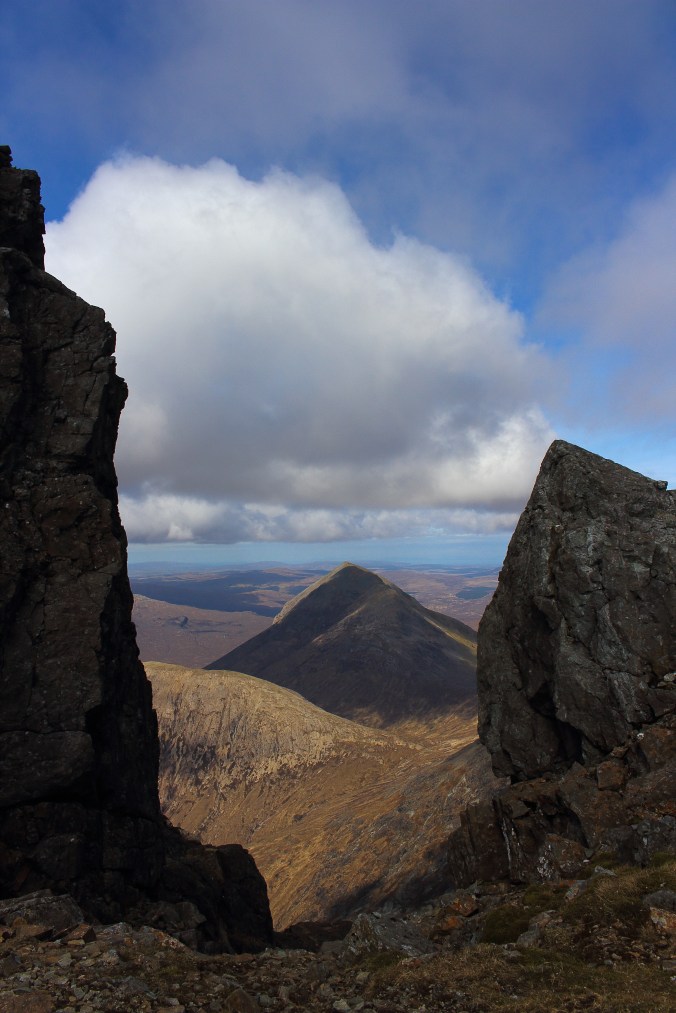
Almost at the summit of Blà Bheinn. A sheer drop only a few meters away — don’t get too close!
And then we finally reached the top.
Standing atop Blà Bheinn, we felt a great sense of achievement, even though it was freezing cold, Arctic winds were mercilessly blowing into our faces and trying to get under our skin, and there was still some snow on the summit.
But THE VIEWS! 😍😍😍
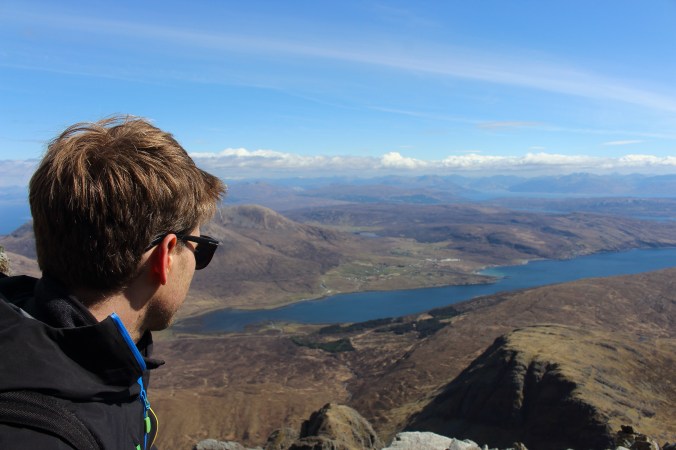
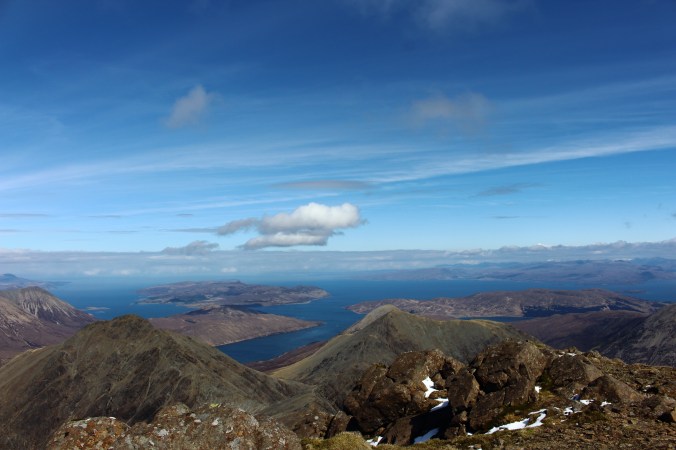
The views spanned 360º and were to die for, truly. It was a super clear day and our guides kept telling us how incredibly lucky we were, that this weather doesn’t grace Skye with its presence too often.
The pictures above don’t do justice to the stunning views — perhaps the video will do a better job:
…
The way down was quicker but was still quite challenging due to gravel. It was quite hard on the knees.
…
After the hike, we felt that our lives were complete. J told me: “Isn’t it amazing how much you can achieve in one day”. And it is amazing — yet so much valuable time is wasted every day on things that are meaningless. This made me think of the S-Town podcast (if you haven’t listed to it, you ought to!) and its character, John. Here is an excerpt from John’s suicide note:
“But the best times of my life, I realize, were the times I spent in the forest and field. I’ve walked in solitude besides my own babbling creek, and wondered at the undulations, meanderings, and tiny atolls that were occasionally swept into its midst. I’ve spent time in idle palaver with Violets, Lileas, Sage, Heliopsis and Monkshood, and marveled at the mystery of Monotropa uniflora. […]
Before I could commence this discourse, I spent a few hours out under the night’s sky reacquainting myself with the constellations like old friends. Sometimes I just spend hours playing my records, sometimes I took my record players and CD players apart, just to peek inside and admire the engineering of their incongruous entrails. Sometimes I watched Laverne & Shirley or old movies or Star Trek. Sometimes I sat in the dark and listened to the creaking of the old house.
I’ve lived on this blue orb now for about 17,600 days, and when I look around me and see the leaden dispiritedness that envelops so many persons, both young and old, I know that if I died tonight my life has been inestimably better than that of most of my compatriots. […] I’d hope that all persons reading this can enjoy some of the aspects of life that I have enjoyed, as well as those aspects that I never will and will take cognizance of the number of waiting days he has remaining and use them prudently.”
I think that mountains have a tendency to make those who come in contact with them quite philosophical — and Scottish mountains are no exception.
…
We then drove to Talisker Bay, where Diageo’s Talisker Distillery is located. We got to the beach at around 8pm, just as the sun was setting down.
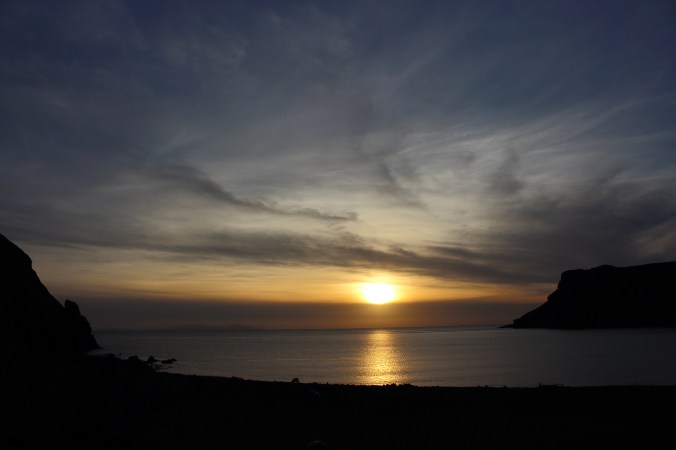

The bay itself is stunning: it is surrounded by rocks, and there is also a waterfall at the far end of the beach.
…
Time has flown by too quickly and, before we knew it, our wee Scottish holiday was nearly over. On day 5, we left Skye early in the morning and drove south, back where were started; we were flying back to London from Edinburgh in the evening.
After a brief pitstop in Fort William, where were refuelled our bodies and minds with coffee, we continued towards Glen Coe. Glen Coe is probably Scotland’s most famous glen. And no wonder — it very scenic.
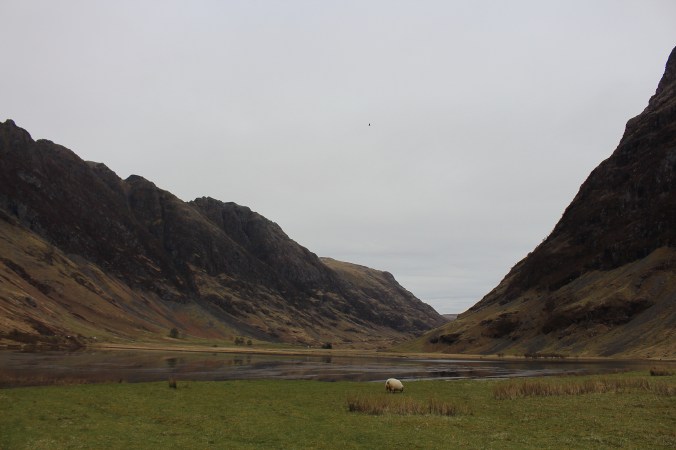
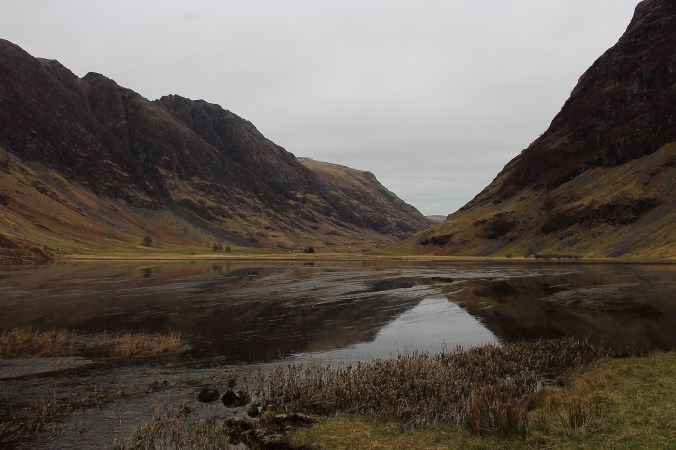
But Glen Coe has some dark past. This is where the Massacre of Glen Coe, possibly one of the worst atrocities to have been committed in Scotland, took place on 13 February 1692.
After the Glorious Revolution of 1692, the Catholic King James VII was ousted, and the Protestant King William II (King William of Orange) took the British throne. There followed a series of battles, in which supporters of James (Jacobites), most whom were from the Highlands, fought against William. William wanted to quash Jacobite loyalties and offered all clan chief an amnesty, provided they swore an oath of loyalty to him by 1 January 1688.
The MacDonalds of Glen Coe were part of the clan MacDonald (which briefly appeared in Part II of this post). Glen Coe had been home to the MacDonalds since the early 14th century, when they supported Robert the Bruce (see Part I of this post). The chief of the MacDonalds of Glen Coe at the time was Alastair MacDonald, who was known as Maclain.
Maclain was 3 days late in taking the oath in Inveraray — he was slowed down by bad weather, and he was also detained for a day by the Campbells, a clan hostile to the MacDonalds. The Secretary of State at the time, John Dalrymple, Master of Stair, decided to use this for his own political agenda. Dalrymple was actually a Lowlander and he did not much like the Highlanders because he thought that Scotland’s interests would be better served in a union with England — and, apparently, he particularly disliked the MacDonalds on Glen Coe. He refused to accept the late oath and ordered that the MacDonalds be slaughtered — “put all to the sword under seventy”. A company of 120 soldiers arrived 12 days before the massacre, under the cover of collecting taxes. The Highland code required clans to provide hospitality to travellers, and the MacDonalds hosted the soldiers in their homes. On the 13 February, the soldiers received their orders and slaughtered the MacDonalds — 38 were killed in total, including Maclain. It appears that some soldiers alerted the MacDonalds to their fate, and some escaped, but 40 more died from exposure to the elements.
We drove to Glencoe village, where there is a monument to those killed in the Massacre of Glen Coe.


It was difficult to shake off the horror of that night as we drove around Glen Coe — 300 years later, it still felt very much present. I saw some beautiful horses in Glencoe village —

— and I love horses, but the feeling of darkness and gloom did not dissipate for a long time.
…
We continued our drive south. We drove off the main road, not really knowing very well where we were driving and why, but soon ended up next to quite a fast river. It was a nice enough river with pleasantly looking surroundings, but we spent a disproportionately long amount of time here because J was trying to take the perfect picture. To that end, he got himself into bizarre and seemingly uncomfortable poses.
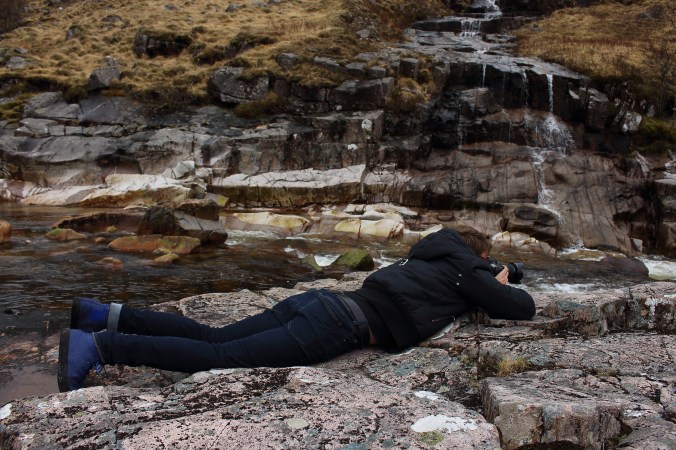
He will do anything for that perfect shot.
I always admire J’s determination when it comes to photography and the lengths he goes to to get that perfect shot. J is a talented photographer and photography makes him passionate, and it’s a wonderful thing. I have just finished reading a book by John Steinbeck called “A Russian Journal”, which is a documentary account of the post-WWII Soviet Union (and it is excellent). He travelled around with Robert Capa, a war photographer and photo journalist (and a co-funder of Magnum Photos). This is what he writes about Capa, with endearing warmth and humour:
“Capa marshalled his ten pieces of luggage and clucked around them like a mother hen. He saw them into a locked room. He wanted the airport officials again and again that they must mount guard over them. And he was never satisfied for a moment while he was away from them. Normally lighthearted and gay, Capa becomes a tyrant and a worrier where his cameras are concerned.”
This may very well have been written about J. 😊
…
Afterwards, we drove through Loch Lomond and The Trossachs National Park for a long time, along Loch Lomond (which is mainland Britain’s largest lake), past Stirling, and to Edinburgh.
…
And so ended our wee Scottish adventure (and I am happy to report that the Glasgow psychic’s prediction did not materialise). The trip was wonderful even if a little too short; you need 5 days for the Isle of Skye alone!
Scotland, I think we will be back. 💙
 WIMO
WIMO 