“When I lifted the Stone in Westminster Abbey, I felt Scotland’s soul was in my hands.”
Ian Hamilton
xxx
Edinburgh, day 1 of our wee Scottish Easter holiday.
On our first day, J and I did some petty touristy things (J’s first time in the city, so we had to). Nevertheless, it was lovely… until the evening, when something freaky happened — but I shall keep you in suspense for the time being.
Our day started quite late because we slept in (shock horror; over breakfast — while listening to this beauty —
— we swore that we’d be getting up bright and early for the rest of our Scottish holiday (and we did stick to it)).
We walked up to Princes Street and climbed atop Castle Rock to see Edinburgh Castle up close (I did warn you — touristy).


Something I did not notice last time I was in the city (back in 2014) were the statues of William Wallace and Robert the Bruce at the entrance gateway of the Castle.


William Wallace (who, to many post 1995, will forever look like Mel Gibson) and Robert the Bruce are probably (at least to the initiated like myself) the most famous Scottish patriots; Robert the Bruce, in particular, secured a victory over the English at Bannockburn in 1314, which is one of the most celebrated moments in Scottish history; Wallace was also one of the central figures of the Wars of Scottish Independence.
…
Everywhere you go in Edinburgh, there is history (a slight exaggeration, perhaps — but seriously, it’s incredibly historic, for lack of a better word). I am, of course, not proposing to offer a comprehensive account of the history of the city in this post — but I can’t resist a temptation to relay what is probably my favourite Scottish story: the story of the Stone of Destiny and its return back to Scotland after being in Westminster Abbey for many centuries.
The Stone of Destiny (also referred to as the Stone of Scone and the Coronation Stone) is quite a grand name, and the name is justified: the Stone played a pivotal role in the coronation of early Scottish monarchs (who placed their feet on the Stone during coronation). It is also believed that the Stone of Destiny is, in fact, the Stone of Jacob: the stone used as a pillow by the patriarch Jacob in biblical times. In 1296, however, the Stone of Destiny was removed from the Scone Palace (near Perth) by Edward I (known as Edward Longshanks and the “Hammer of the Scots”) as spoils of war and taken to Westminster Abbey. There, it was fitted into a wooden chair (so-called “King Edward’s Chair”), on which almost every English and British monarch — including the current one — was subsequently crowned.
…Fast forward from 1296 to 1950. In 1950, 4 Scottish students, Ian Hamilton (who later became a QC), Gavin Vernon, Kay Matheson and Alan Stuart, devised a bold plan which would culminate in the return of the Stone of Destiny to Scotland. On Christmas Day 1950, they removed the Stone from Westminster Abbey, having dropped and broken it into two uneven parts in the process (it also landed on one of the conspirators, who broke two of his toes). They eventually managed to remove the Stone, now in two parts (which, according to Hamilton, was more handy as the Stone was no feather) from the Abbey and drove north in two cars. The theft of the Stone was quickly discovered and the border between Scotland and England was closed — apparently, for the first time in 400 years. Kay Matheson, who had the smaller piece of the Stone in her car, left it with a friend in the Midlands, whilst Vernon, Hamilton and Stuart dug their part of the Stone somewhere in the in a field in Kent. The conspirators then returned to Scotland, but a fortnight later Hamilton succeeded in recovering the two pieces and brought them back to Glasgow, where the Stone was mended. Eventually, Vernon, Stuart and Hamilton delivered the Stone to the ruined Abbey of Arbroath, where they had arranged to meet two Arbroath town councilors. The councilors then reported the presence of the Stone to the police, following which it was returned to Westminster.
I find this story fascinating (a detailed account of it can be found here and here). Interestingly, back in the early 1950s, fewer than 1% of Scots supported the SNP — look at what we have 60+ years later, and perhaps Hamilton et al. did indeed succeed in raising awareness of what they apparently saw as Scotland’s subordinate status within the UK.
Now, fast forward to 1996: on 30 November (St Andrew’s Day), the Stone of Destiny was installed in Edinburgh Castle, where is currently remains. That was done by the Conservative Party in a transparent attempt to boost its popularity before the general election the year later. The plan failed spectacularly: Conservatives got zero seats.
In conclusion and to add to the mysteriousness of the Stone of Destiny, some believe that the stone which was lain in Edinburgh Castle is not, in fact, the real Stone — one of the sub-theories of this so-called “Westminster Stone theory” is that Edward was fooled and given an imitation of the Stone back in 1296. Who knows.
After Edinburgh Castle, we walked down to Royal Mile, past St Giles Cathedral —
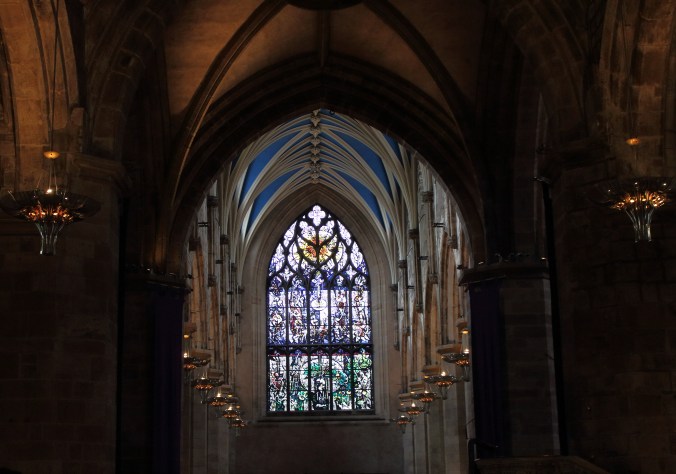
— Real Mary King’s Close and other historical buildings, to the Scottish Parliament Building.
The Parliament only opened in 2005 following the referendum in 1997, in which the Scots voted (overwhelmingly) to set up a Scottish parliament. Amusingly, when the previous referendum on the subject was held in 1979, 52% voted in favour of devolution, but the PM at the time, James Callaghan, decided that all those who did not vote should be counted as “No”, and the proposal was rejected. Can we re-assess the Brexit vote last year using the same principle please (only half joking…)?
The Parliament Building was designed by Enric Miralles, a Spanish architect, and is no ordinary building. It’s a pretty bizarre concrete formation.
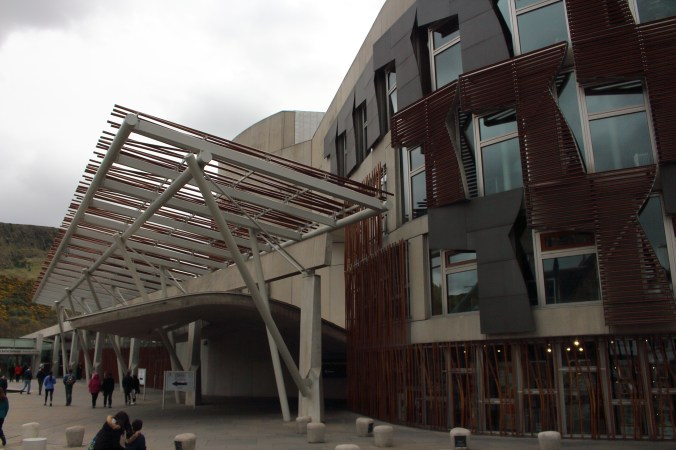

Miralles had a very unique architectural vision; it seems to me that he was, if I can call him that, a “poet-architect”. His concept for the design of the Parliament was an “intellectual vision was for a unique institution – open, anti-classical and non-hierarchical”. Miralles described the Scottish Parliament as “sitting in the land”: “[t]he Parliament sits in the land because it belongs to the Scottish Land. …We don’t want to forget that the Scottish Parliament will be in Edinburgh, but will belong to Scotland, to the Scottish Land. The Parliament should be able to reflect the land which it represents. The building should originate from the sloping base of Arthur’s seat and arrive into the city almost out of the rock”. See what I mean when I say “poet-architect”?
The fact that the design of the Parliament is so unusual and elaborate is actually quite ironic, because the original concept envisaged that the building would be modest: “We sat down with Donald [a Scottish politician and the driving force behind the project] and asked him, ‘what do we need?’ He replied: ‘I want a first-class, functional office building – but nothing too elaborate, boys! This is presbyterian Scotland!’“. Perhaps that was part of the reason why the initial estimate for the project, which was between £10 and £40 million (according to the final version of the White Paper on Scottish Devolution) was vastly exceeded — the final cost of the Scottish Parliament Building was c.430 million (in 2004, a report following a public inquiry — the Holyrood Inquiry — into the cost over-run and the delays in the construction of the Parliament was published).
…
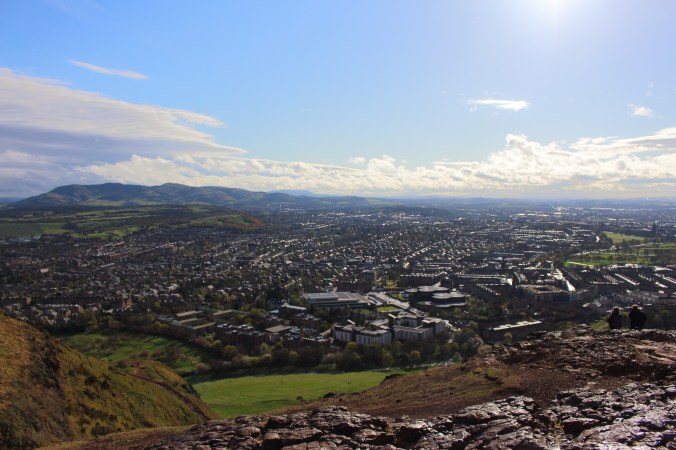
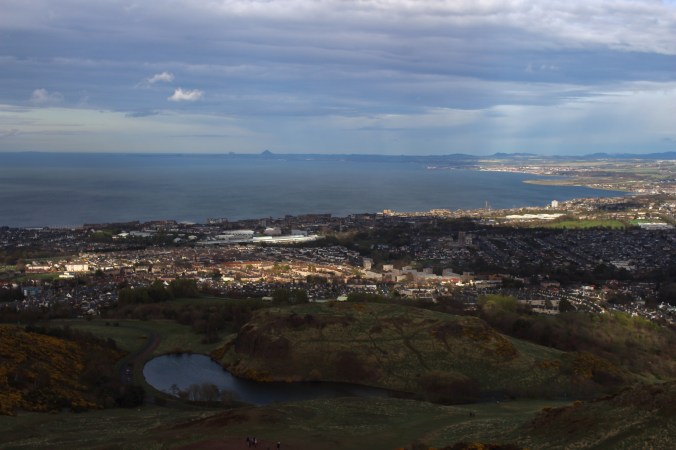
In the afternoon, we climbed Arthur’s Seat. By the time we got to the top, the rain had subsided, and the summit rewarded us with spectacular views of the city (Arthur’s Seat is 250.5m heigh) — albeit it was exceptionally windy!

We made our way down —
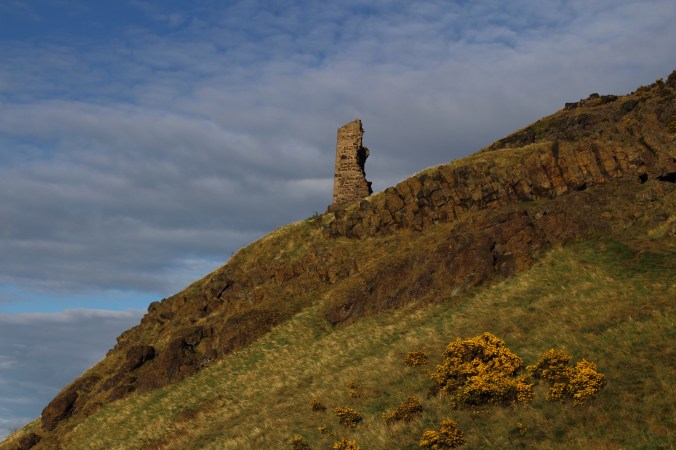
— and ended up in Holyrood Park, where we spent what seemed to be an eternity watching swans at Dunsapie Loch.

What surprised me about them was how incredibly docile they were; whenever I’m in the vicinity of swans, I expect to be attacked every minute, but these guys didn’t even bat an eyelid at the presence of humans (in fairness, they were also quite fat and moved around very reluctantly preferring to stay on the same spot instead, which may have been part of the reason). Last year, a tragedy struck the Swan Lake of Holyrood Park, when Sally, one of the long-term residents of the loch, vanished; it was suspected that she was eaten by a fox. Sally and Sid had been together for 16 years (this is way longer than any of my relationships!), and poor Sid was left without his mate.
…
And now, the freaky thing I mentioned at the start of this post. We went out for dinner in the evening to a lovely restaurant called First Coast. So we are sitting at this cute little table by the window and are eagerly awaiting our food (I am, as usual, starving). And then this guy stumbles in. He is in his late 50s or early 60s, quite well dressed but really quite drunk. He exchanges a few words with one of the waitresses (who is politely asking him to leave) and then notices me and J. He says: “You are in love. You should get married. I see these things”. I smile and he leaves the restaurant. A few seconds later, he is on the other side of the window, and he is is pointing his finger at me and desperately trying to tell me something. A elderly lady then appears and attempts to help him stay on his feet. Seconds later, he bursts into the restaurant again, full steam ahead to our table. He tries to get close to me, looks at me intensely and says things along the lines of: “I need to warn you. I can see danger. There is danger ahead. He [pointing at J] will be driving. There will be an accident. A car crash. Trouble is coming”. The restaurant staff tried to make him leave the restaurant, which he does eventually, repeating all the time: “I just want to warn her”. I am unsure if you can tell from the image below, but I’m more than a little shaken by the experience as we are supposed to rent a car the next day to drive up to the Highlands (with J being the only driver on the license).

The waitress apologises and we tell her there is nothing to worry about; I then ask her whether she’s ever seen the guy before. “No, — she says, — it’s the first time he’s come here. He said he was a psychic from Glasgow”. Seeing that I’m in no better state after her explanation, J decides to go and find the guy. He leaves. After some 5 minutes, he is back. Turns out the elderly lady we saw earlier and some other guy were helping him to get home. J asked the lady (who said she knew him) whether the guy was a psychic and she said he was not. The guy himself did not give J any further information.
And so ended day 1 of our wee Scottish adventure.
 WIMO
WIMO 