Uzbekistan.
Uzbekistan was probably the first item which was added to my long, and, to date, ever growing, “places I want to go to” list. This is because Uzbekistan is my historical motherland (or, rather, one of) — my grandma on my mum’s side was born there, and my grandparents lived and raised my mum there before moving to a country with more moderate temperatures in the early 1980s. It would then come as no surprise that I grew up listening to stories about Uzbekistan and, in particular, about the city of Navoi, where my family lived. My granddad was an exceptional story teller and, being the impressionable child that I was, I resolved very early on that I wanted to — had to! — go and see Uzbekistan with my own eyes.
Fast forward 20 years, and it didn’t take me long to figure out where to go on my qualification leave in September 2014 — Uzbekistan, naturally — this was such a perfect opportunity. (Now, because, as people who know me would say, I don’t do things by halves, I also decided to use the time I had to travel around two other “Stans” — Kyrgyzstan and Tajikistan — but this is a story for another time.)
We took a domestic flight from Tashkent to Urgench (having flown into Tashkent from Bishkek in Kyrgyzstan a few hours earlier); Urgench is only a short drive away from Khiva.
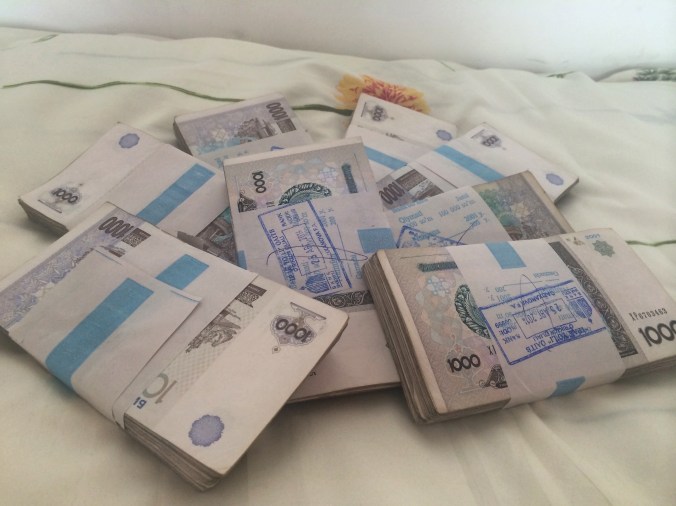
I remember getting into our guest house when we just arrived, emptying a bag of local money, the som, and being like, wow, I feel rich. It’s easy to feel rich in Uzbekistan as the exchange rate is so skewed (not in favour of the som). But it certainly cheered me up after my experience at the Tashkent airport earlier that day, where I was locked in a room for several hours and interrogated in a rather intense manner by a rather questionable local official on the status of my visa (don’t ask…) and nearly missed my flight to Urgench as a result. Still, all part of the experience.
The Khiva old town breathes history. And no wonder — according to one legend, Shem, one of Noah’s sons, once found himself wondering in the desert alone and fell asleep. He dreamt of 300 burning torches (I’m unsure as to the significance of this number…). When he woke up, Noah believed it was an omen and founded a city with outlines in the form of a ship mapped out based on the arrangement of the torches in his dream. Shem then ordered to dig a well called Kheyvak (apparently, loosely translated as “sweet water”) — hence Khiva’s name.
Beautiful, right? The history of Khiva and other khanates which later came to form the modern day Uzbekistan is somewhat less poetic and often pretty brutal. Khiva became a very important city on the Silk Route and replaced Urgench as the capital of the Khanate of Khiva in the early 17th century. Khiva had also the largest slave market in Central Asia. From Captain Nikolai Muraviev’s 1871 book “Journey to Khiva through the Turkoman Country”:
“The Masters have full powers of life and death, but as the death of a slave is a direct loss of property, they generally chastise light offences by cutting off an ear, or thrusting out an eye, or by stabs with a dagger in some not vital part. […] [These] minor punishments […] are inflicted for meditated desertion, but should a slave be suspected a second time of the intention of running away, he is nailed by an ear to a post or to the house door, and left for three days without food or drink, exposed to the jibes of passers by. Few survive this, as they enter on the ordeal with frames already exhausted by toil and hardship.”
Khiva’s history is also fascinating because of its role in the so-called “Great Game” — a geopolitical confrontation between the Russian Empire and Great Britain to gain control over India, Afghanistan and Central Asia in the 19h century. Peter Hopkirk’s book “The Great Game — On Secret Service in High Asia” offers a fascinating account of this period. Here is one snapshot…
The origins of the Great Game can be traced back to Peter the Great, who decided to tap into Central Asia’s rich gold reserves and also, through gaining control over the region, obtain access to the resource-rich India, which he knew the British had already been getting their hands on. To further his ambitions, he sent a diplomatic mission led by Prince Bekovich to Khiva (the Khan of Khiva had approached Peter a few years prior with an offer to become his vassal in exchange for Russia’s protection, but Peter had little interest at the time). The mission reached Khiva after a long and exhausting journey in 1717. The mission’s couriers delivered lavish gifts for the Khan, courtesies were exchanged and the Khan then told Bekovitch that it would not be possible to accommodate the whole mission in Khiva and proposed that it be split up into several groups and housed in nearby villages. Conscious of not causing offence the Khan by his refusal, Bekovith agreed. Big mistake, of course — everyone but a small minority of Russians was slaughtered and Bekovitch’s head was severed, stuffed with straw and left on display. Just over 100 years later, Captain Nikolai Muraviev embarked on another mission to Khiva, one of the aims of which to was to collect as much military and economic intel about the Khanate as possible (“Journey to Khiva through the Turkoman Country” contains detailed descriptions of, amongst other things, Khiva’s strongholds, artillery and trade relations).
So yes, brutal but fascinating past, but I’m getting a bit carried away.
Khiva’s old town (Ichan-Qala, added to the UNESCO heritage list in 1990) is beautiful and extremely well preserved, where the past feels almost like now. It is surrounded by a 7-8m high fortification wall and has an abundance of beautiful mousaleums, madrasas and mosques.
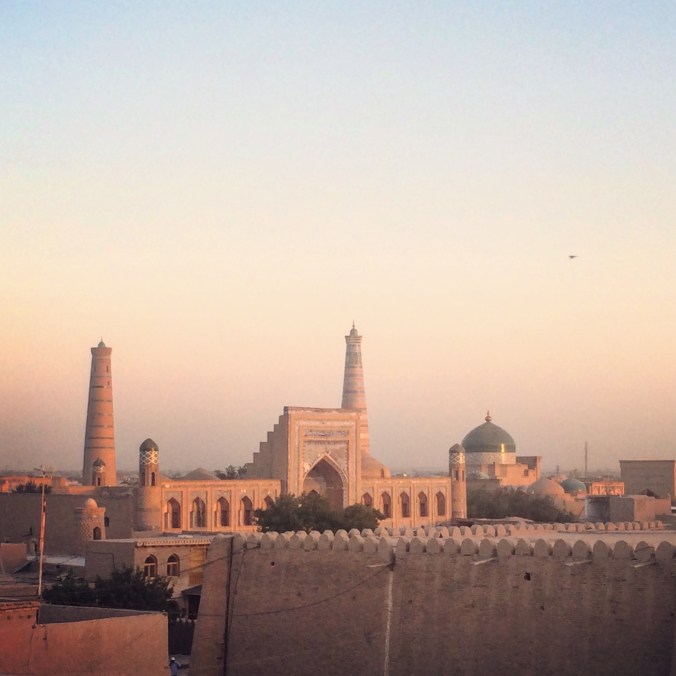
You can actually walk all around the perimeter of the wall. As I like climbing things, I of course couldn’t miss the opportunity.

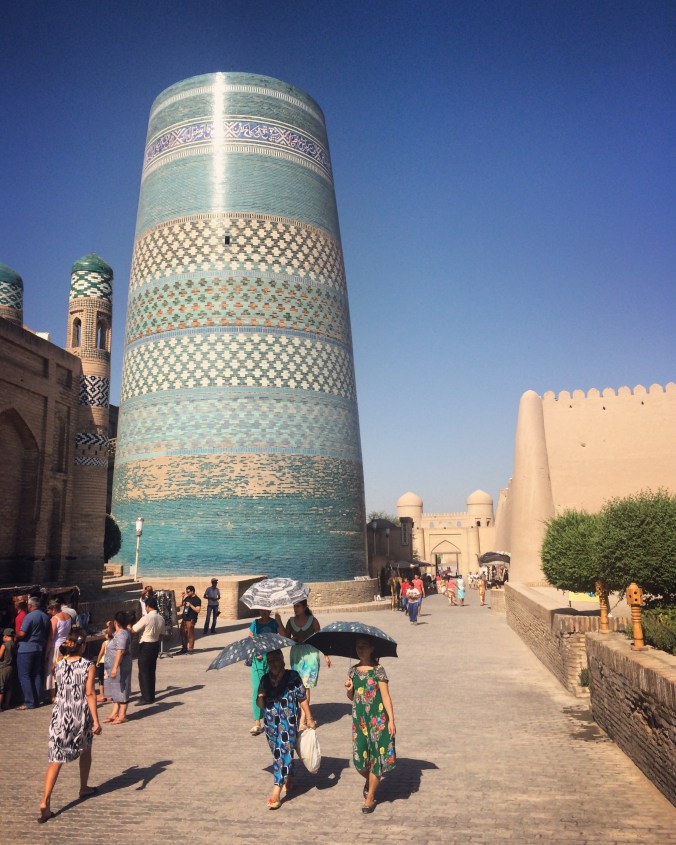
The most iconic building in Khiva is probably Kalta Minor Minaret, pictured below with some lovely local ladies in the foreground trying to protect themselves from the sun (the heat was unbearable… the temperatures were somewhere in the early forties but it felt much hotter because of humidity). The minaret isn’t actually that old in comparative terms — the construction finished in 1855. I really liked the blue tiling but was also a little puzzled but just how fat the minaret looked. Apparently, it was supposed to be 70 metres high, but when Muhammad Amin Khan was killed, the construction stopped at the current 29 metres, which explains the visual imbalance.
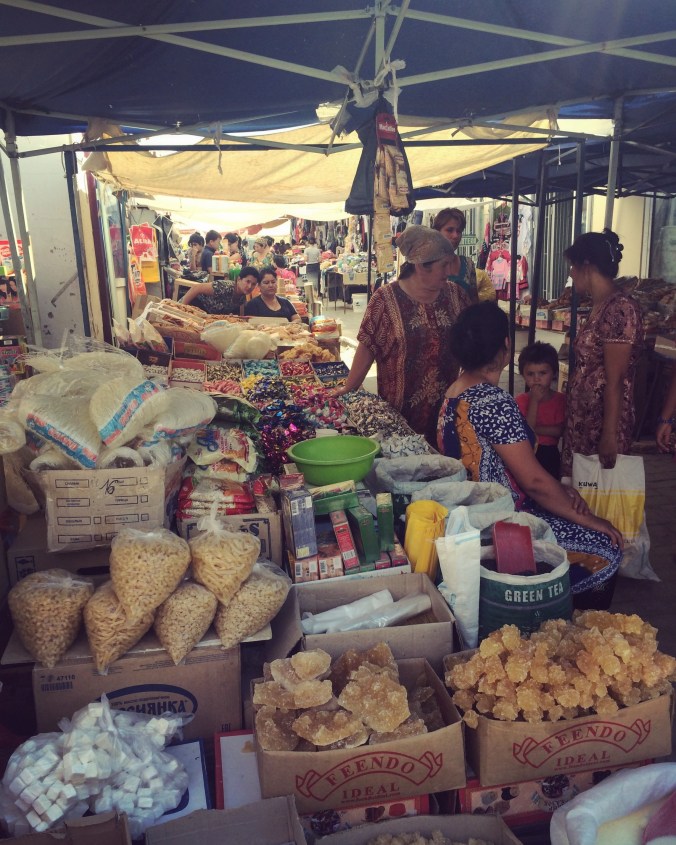
Bazaars (markets) are very prevalent across Central Asia and, dare I say, are part of the local culture. A bazaar offers pretty much everything under the sun (at the end of my Central Asia trip, I found myself in Osh in Kyrgyzstan; Osh has the largest market in Central Asia and it was truly mind blowing, both in terms of its vastness and the available choice — I bought my grandma a camel hair belt to ease her back aches). But a bazaar is much more than your bog-standard western supermarket — it’s a place where people socialise, exchange news and have a bit of fun haggling (amusingly, haggling terrifies many Westerners, but it is a form of art).
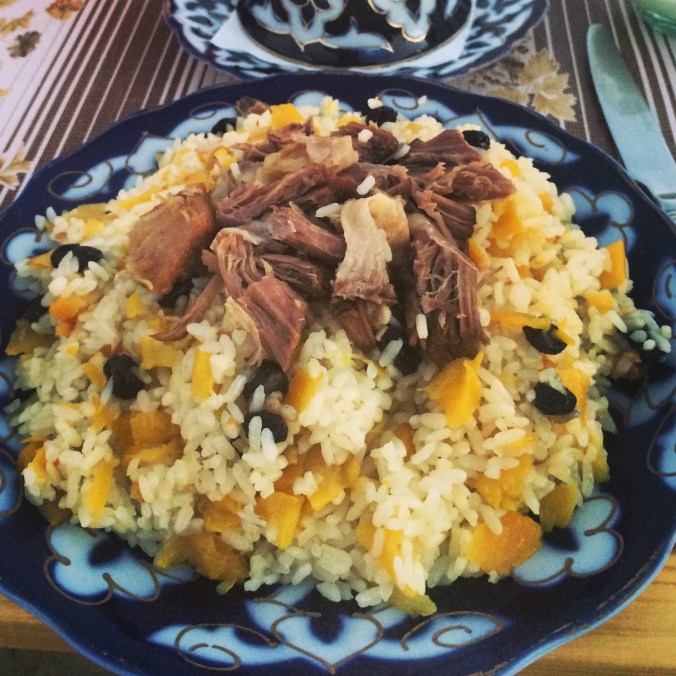
It goes without saying that no travel experience is complete without savouring local delicacies and, as I write this, I can almost smell the aromas of my grandma’s plov. We did try local plov — nowhere near as good as my grandma’s, but still excellent.
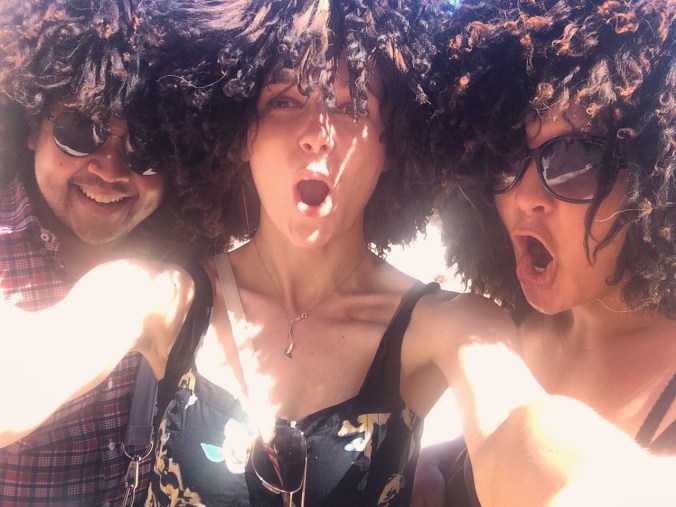
A uniquely Khivan experience was trying on and eventually purchasing — we couldn’t resist — local wool hats, known as chugirmas. I should emphasise that these hats are unique to the region and not found anywhere else in Uzbekistan (as far as I know), so are really quite special. Here is interesting blog post explaining the history and use of chugirmas. A lot of this was unknown to us at the time, but we were told that these hats help regulate the temperature of the head and can — should, in fact — be worn in both cold and hot weather. And so we did put this to test that same afternoon, in the intolerable heat (see my note above). We climbed up the great wall of Khiva and wore our chugirmas. Our heads were surprisingly very comfortable, and the chugirma challenge was successfully passed.
In the evening, we got on an sleeper train to take us to the young city of Navoi.
To be continued.
 WIMO
WIMO 